
This post is also available in:  English
  Français (French)
Updated version August 2026
North America is losing forest faster than its nurseries can replace it. Wildfires keep breaking records, the backlog of land waiting to be replanted keeps growing, and the operations that stand between a burned hillside and a living forest are the same tree seedling nurseries that are now squeezed by rising demand, volatile funding, and a shrinking workforce. In that context, the temptation is to reach for the most advanced greenhouse on the market. That instinct is usually wrong. Successful greenhouse tree seedling production for reforestation does not come from the most technology. It comes from the right technology, matched to a hardy crop, aimed at the real bottleneck, inside a structure built to protect a crop that lives for years.
This is the #RightTech lens applied to reforestation. Agronomy first, then the machine that actually earns its keep.
A forest deficit that will not wait
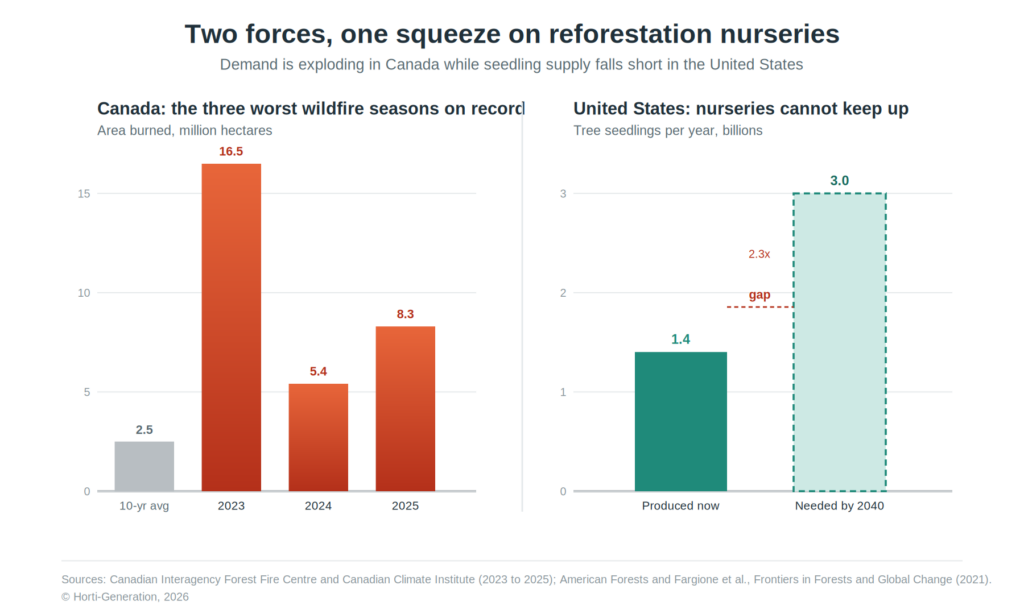
The demand side is no longer a forecast. It is a structural, permanent reality. Canada’s 2023 fire season burned well over 18 million hectares, more than six times the long-term average, according to the Canadian Climate Institute. It did not stop there. Between 2023 and 2025, fires moved through roughly 31.5 million hectares, and the Canadian Tree Nursery Association estimates that about 7.35 billion trees were lost that will not grow back on their own, as reported by the Globe and Mail. By 2027, Canada is projected to need as many as 350 million seedlings every year to keep pace with restoration needs.
The picture south of the border is the same shape. American nurseries currently produce around 1.3 to 1.4 billion seedlings per year. To meet national reforestation goals by 2040, that output would need to rise between 2.3 and 3.6 times, according to American Forests and the peer-reviewed analysis published in Frontiers in Forests and Global Change. In the West, post-fire conifer seedling shortages have already delayed replanting on land that cannot regenerate naturally.
Here is the key point for a nursery operator. Fire cycles are lengthening, not shrinking. The demand for reforestation seedlings is not a spike to ride out. It is a new baseline to build for.
The two things a nursery cannot buy its way out of
If demand is the easy part of the equation, supply is where operations fail. And two constraints matter more than any piece of equipment.
The first is funding. It is volatile, and it flips with the political cycle. Canada’s flagship 2 Billion Trees program is a clear example. As announced in the federal fall budget of 2025, the program is being wound down. Existing agreements will be honoured, but no new applications are accepted, and only about 228 million of the promised two billion trees were planted. Meanwhile, the United States is pushing the opposite way through the REPLANT Act. The lesson for a grower is not political. It is operational. Do not build a business model that only survives inside a subsidy window. Build one that stays efficient when the subsidy disappears.
The second constraint is labor, and it is the real ceiling. The United States Forest Service nursery system could deliver roughly 11 million additional seedlings every year if it were simply fully staffed, according to the joint federal reforestation report. American Forests found the same thing when surveying nursery operators: the single largest barrier to scaling production is finding and keeping people who can do the work. In Canada, the planting and nursery workforce leans heavily on youth, rural, and Indigenous workers, and it is hard to recruit and retain.
So the honest question is not how much technology a reforestation nursery should buy. It is how to grow more seedlings with less public money and less available labor. That is a #RightTech question, and it points to a very different answer than a catalogue of high-tech features.
Why reforestation is a #RightTech problem, not a high-tech one
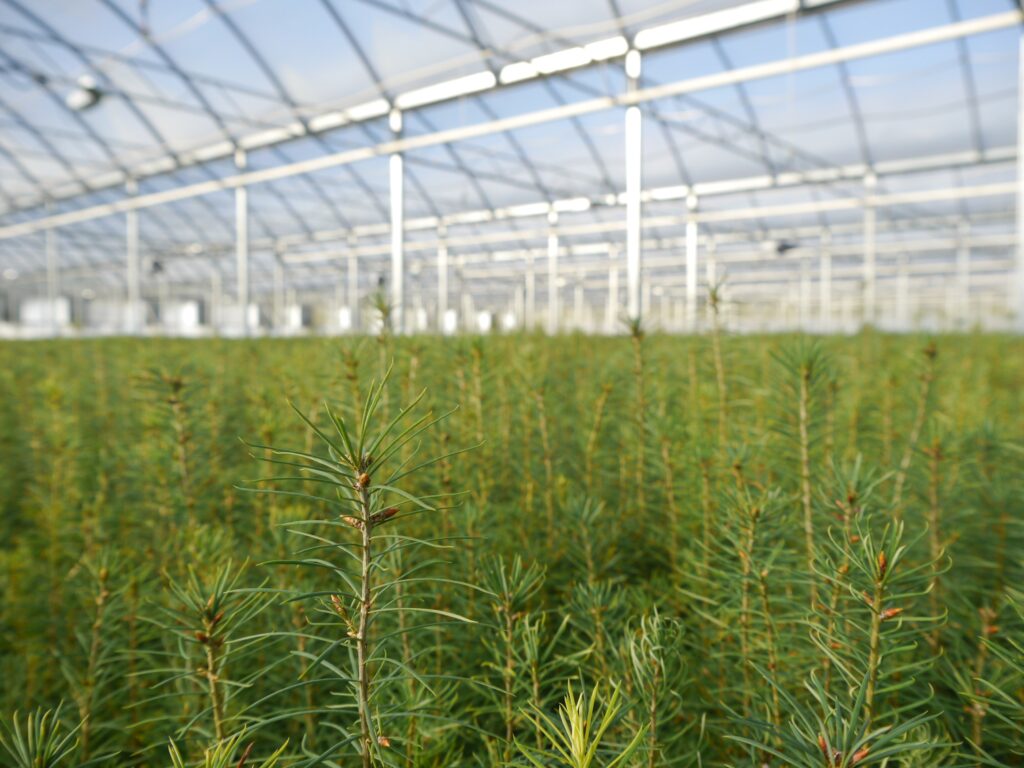
Start with the crop, because the crop decides the technology. Reforestation species such as white spruce, balsam fir, lodgepole and jack pine, poplar, and paper birch are far less demanding than tomatoes, cucumbers, or leafy greens. They tolerate wider swings in temperature and humidity. Most of them require a dormancy period of at least two months. They do not need a permanently optimized climate. They need a controlled one at the right moments.
This matters because every dollar spent gold-plating a climate system for a crop that does not need it is capital you will not recover. #RightTech means matching the technology to the biology first. For forestry seedlings, control genuinely pays in three specific places. It pays for photoperiod and blackout management, which lets a nursery induce dormancy on schedule and plan production precisely. It pays for protection against extreme events, which are now the norm rather than the exception. And it pays for uniformity, because a homogeneous, well-hardened seedling survives transplanting far better in the field. Beyond those, added technology tends to add cost faster than it adds value.
The real bottleneck is handling, not climate
Walk through a reforestation nursery and watch where the hours go. They go into sowing, thinning, transplanting, grading, and moving millions of small plugs from one area to the next. That is where labor is consumed, and therefore that is where automation returns money. Not on a more sophisticated climate computer.
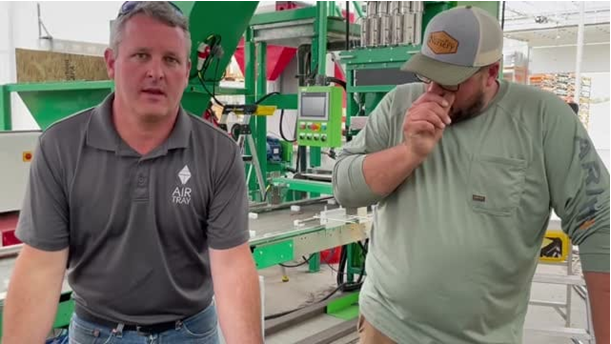
This is exactly where targeted semi-automation earns its place, and where the most useful lesson from the field comes in. Michael Taylor of the Blackmore Company has described the Air Tray approach built around a simple principle: one seed equals one tree. Precision sowing removes the need to thin extra germinants, which conserves seed, a finite and irreplaceable resource in reforestation, and cuts the labor that thinning demands. The Air Tray design also leaves an intentional gap between the paper-wrapped growing medium and the tray. That gap improves air circulation and drives healthier wet and dry cycles, which increases stem caliper and feeder root development, and in turn improves water and nutrient uptake.
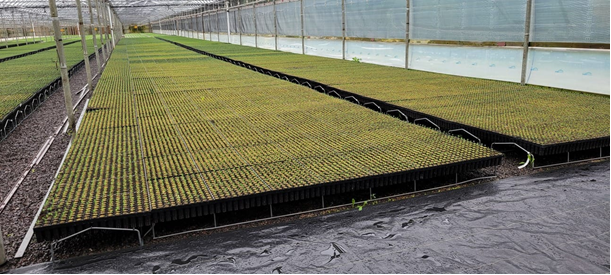
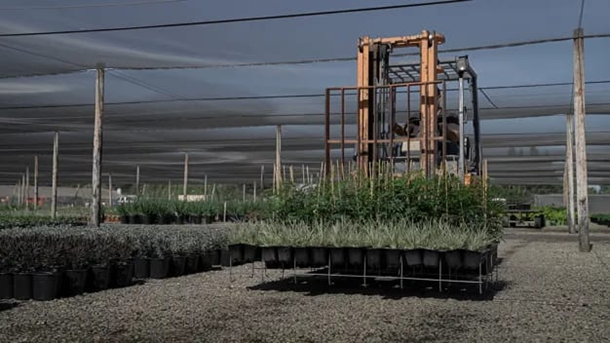
Automated racks then move plants from transplanting through to grading, which reduces manual handling and improves airflow around the crop, lowering the risk of pathogen transfer. Taylor’s detailed session for the Canadian Institute of Forestry is available here.
Read that carefully through a #RightTech lens. None of it is about a fancier greenhouse. All of it is about attacking the labor and seed bottlenecks directly. That is the right technology, aimed at the right constraint.
Structures built to protect a multi-year crop
A vegetable crop turns over in weeks. A reforestation seedling can spend one to four years under production before it is planted. That single fact changes how you think about the structure. One failure, one uncontrolled heat event, or one collapsed roof under snow load can erase a full season of genetics that took years to build.
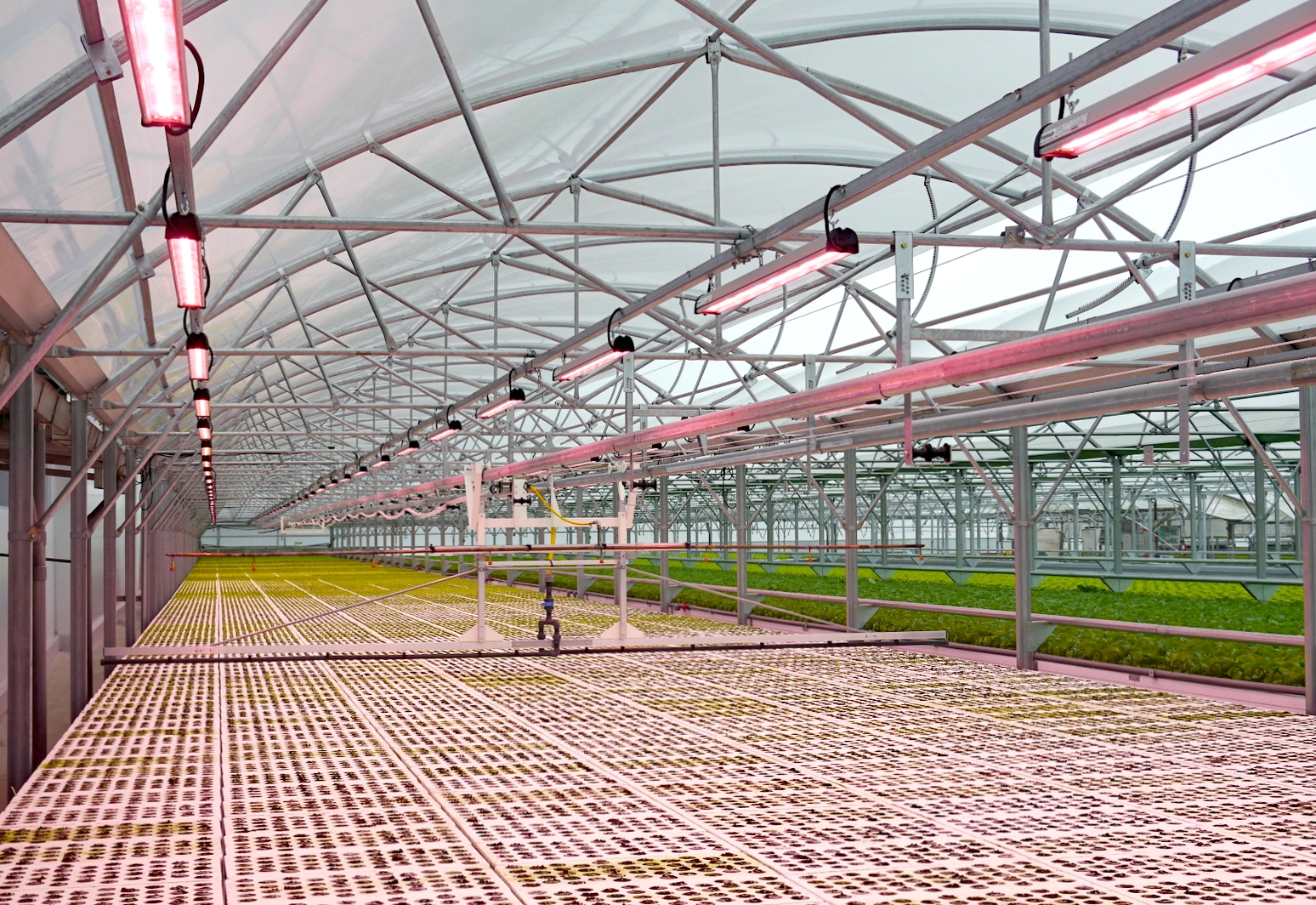
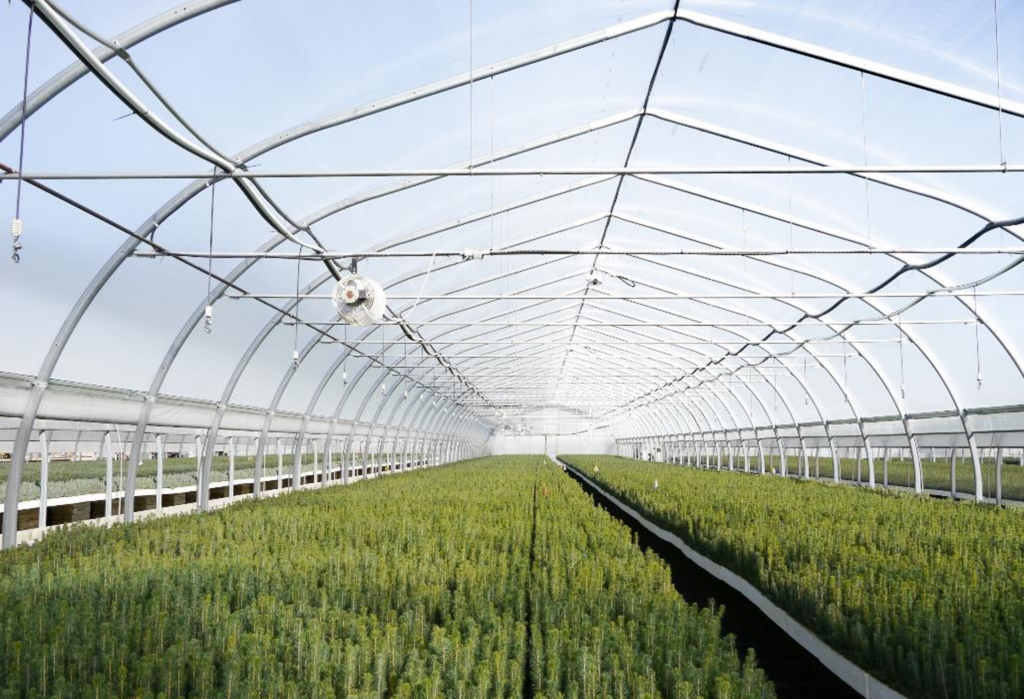
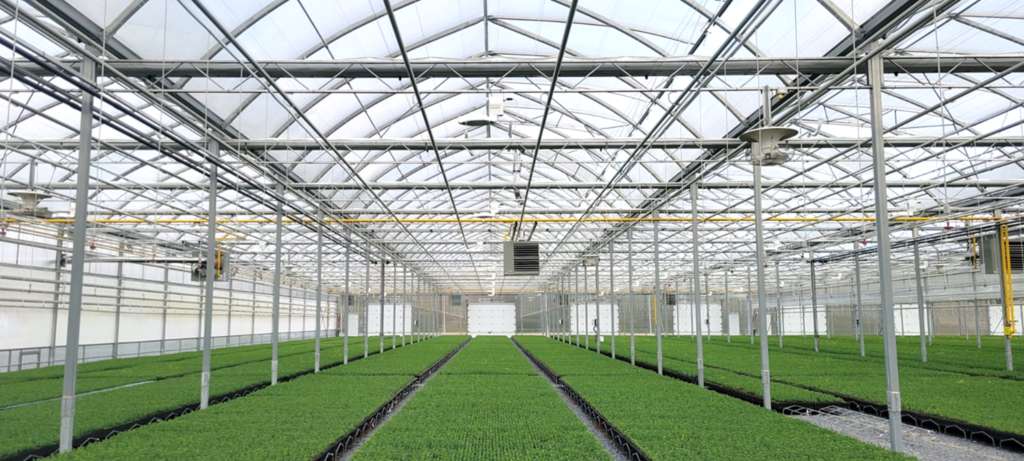
So the structure is not a commodity. It is insurance on a long crop. The design principles that matter most are resilience and the buffer effect. A greenhouse built with generous width and height carries a larger air mass, and that buffer effect smooths out temperature and humidity swings, maximizes natural light, and supports effective passive ventilation. A gothic arch profile sheds snow rather than accumulating it, which protects the crop through a northern winter. A double poly covering delivers real thermal buffering at a fraction of the capital cost of glass.
There is a reason the same design language keeps showing up across serious forestry nurseries on this continent. The engineering is not generic. It comes from a small group of North American builders who spent decades refining freestanding gothic and gutter-connected poly houses for this exact crop, with oval-tube framing and stamped snow and wind loads built for northern winters. The scale of the trust behind those designs is telling. The largest forest seedling producer in North America has grown more than five billion seedlings, the majority of them inside poly houses from a single Canadian manufacturer. When an operation at that scale standardizes on one builder’s structures, that is a signal worth reading.
For most reforestation nurseries across Canada and the northern United States, that points to mid-tech poly gutter-connected houses or large tunnels rather than glass. Where year-round, multi-cycle production justifies it, supplemental lighting with tuned spectra can help, and there is evidence that specific LED spectra improve root development in conifers such as Pinus sylvestris, according to trials reported by Valoya. But that is an addition on top of the right envelope, not the reason to buy the most expensive envelope.
Matching technology to the tier
Put the pieces together and a simple decision framework emerges. It is not a ladder you must climb to the top. It is a set of tiers, and the goal is to choose the lowest one that meets the crop and the bottleneck.
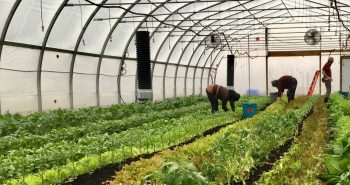
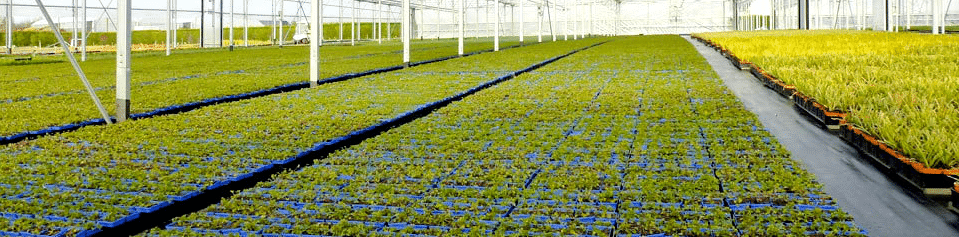
Low-tech tunnels are the entry point. They offer season extension at the lowest capital cost, and they suit hardy species and shorter cycles. Mid-tech poly gutter-connected greenhouses are the sweet spot for most programs that need scale. They deliver the buffer effect, room for semi-automation on the handling steps, and controlled dormancy, at the best ratio of cost to resilience. High-tech glass or fully automated systems are justified only where year-round multi-cycle production and premium genetics pay back the capital, which in practice means large, well-capitalized operations.
The decision rule is the whole point. Start from the crop and the labor bottleneck, then choose the lowest tier that satisfies both. That discipline is what #RightTech means in practice, and it is what keeps a nursery solvent when the subsidy cycle turns.
The takeaway for reforestation nurseries
The nurseries that survive the funding whiplash and the labor squeeze will not be the ones with the most technology. They will be the ones that matched the right technology to a hardy crop and to a real constraint. Reforestation does not need more machines. It needs the right ones, in the right structure, at the right scale. That is how greenhouse tree seedling production becomes both efficient and resilient, and it is how nurseries can actually keep pace with the forests we are losing.
Beyond conifers: the hardwoods still to come
One last thought, because the story does not end with conifers. Most post-wildfire replanting in the boreal north leans on spruce, fir, and pine, and that is where this article has stayed. But a restored forest is not a monoculture. Broadleaf hardwoods such as oak and birch carry much of the biodiversity, the wildlife value, and the long-term climate resilience that separate a real forest from a plantation.
Hardwoods also change the nursery equation, which is exactly the point of a #RightTech approach. Their seed behaves differently. Acorns are recalcitrant and cannot be frozen and banked like conifer seed. Stratification, container choice, and production cycles all shift with the species. Some hardwoods that were once nursery staples now face heavy pressure too. Ash is being hollowed out by the emerald ash borer, and beech is under strain from leaf and bark disease, which is pushing nurseries toward resistant genetics and a wider palette of broadleaf species. Growing oak, birch, and their hardwood companions well is a different craft from growing spruce plugs. It deserves its own article, and that is where we will go next.
Sources
- Canadian Climate Institute, wildfire impact on the forest sector, 2024: climateinstitute.ca
- Canadian Tree Nursery Association analysis, reported by the Globe and Mail, 2025-2026: theglobeandmail.com
- Natural Resources Canada, 2 Billion Trees program wind-down: natural-resources.canada.ca
- American Forests, The Reforestation Pipeline: americanforests.org
- Fargione et al., Challenges to the Reforestation Pipeline in the United States, Frontiers in Forests and Global Change, 2021: frontiersin.org
- USDA, joint federal reforestation report (nursery capacity and staffing): usda.gov
- Michael Taylor, Blackmore Company, optimizing seed usage and reducing labor with Air Tray technologies, Canadian Institute of Forestry, 2022: cif-ifc.org
- Valoya, LED spectra and conifer root development: valoya.com