
This post is also available in:  English
  Français (French)
Structure is the first #RightTech decision
Before a grower specs a climate computer, a screening system, or any piece of automation, one choice quietly sets the ceiling on everything that follows. That choice is the structure itself. This is the heart of the #RightTech approach: agronomic reasoning comes first, technology second. A brilliant climate strategy cannot rescue a frame that shades the crop, and no controller can compensate for a structure that was never designed for the loads its site actually sees.
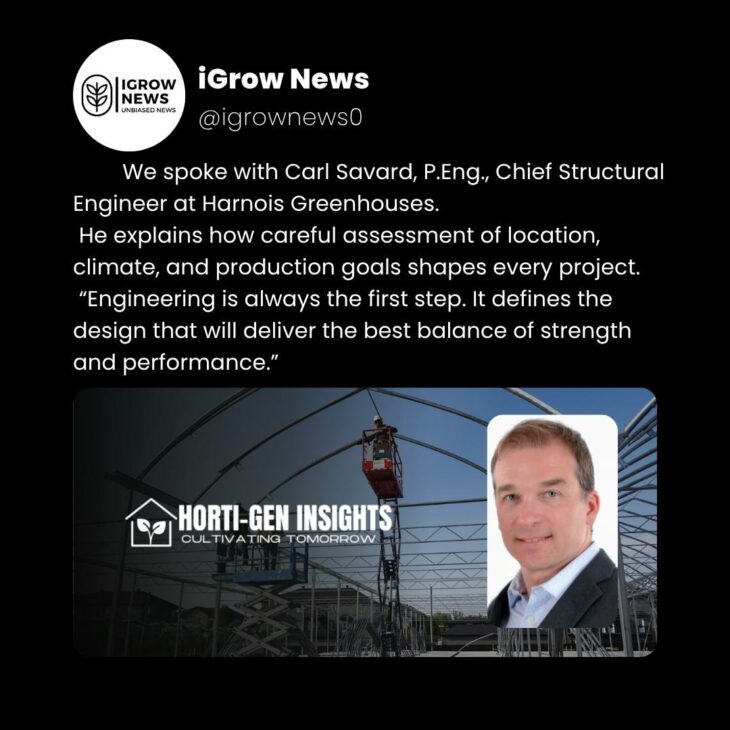
Climate-adapted greenhouse design starts here, at the envelope. To dig into how structural engineering shapes both yield and resilience, we spoke with Carl Savard, P.Eng., chief structural engineer at a Québec greenhouse manufacturer (Harnois Greenhouses) with a long record in heavy-snow and high-wind regions. His view is blunt and useful.
For us, engineering is always the first step. It defines the design that will deliver the best balance of strength and performance for the client.
Carl Savard, P.Eng.
Why the frame sets the ceiling on yield
Light is the raw material of production. Across the practical range, the relationship between light and yield is close to linear. The well-known rule of thumb, evaluated across many greenhouse crops by Marcelis and colleagues (2006), is that a gain of roughly 1 percent in light delivers a gain of roughly 1 percent in yield. That single fact changes how we should read a steel drawing.
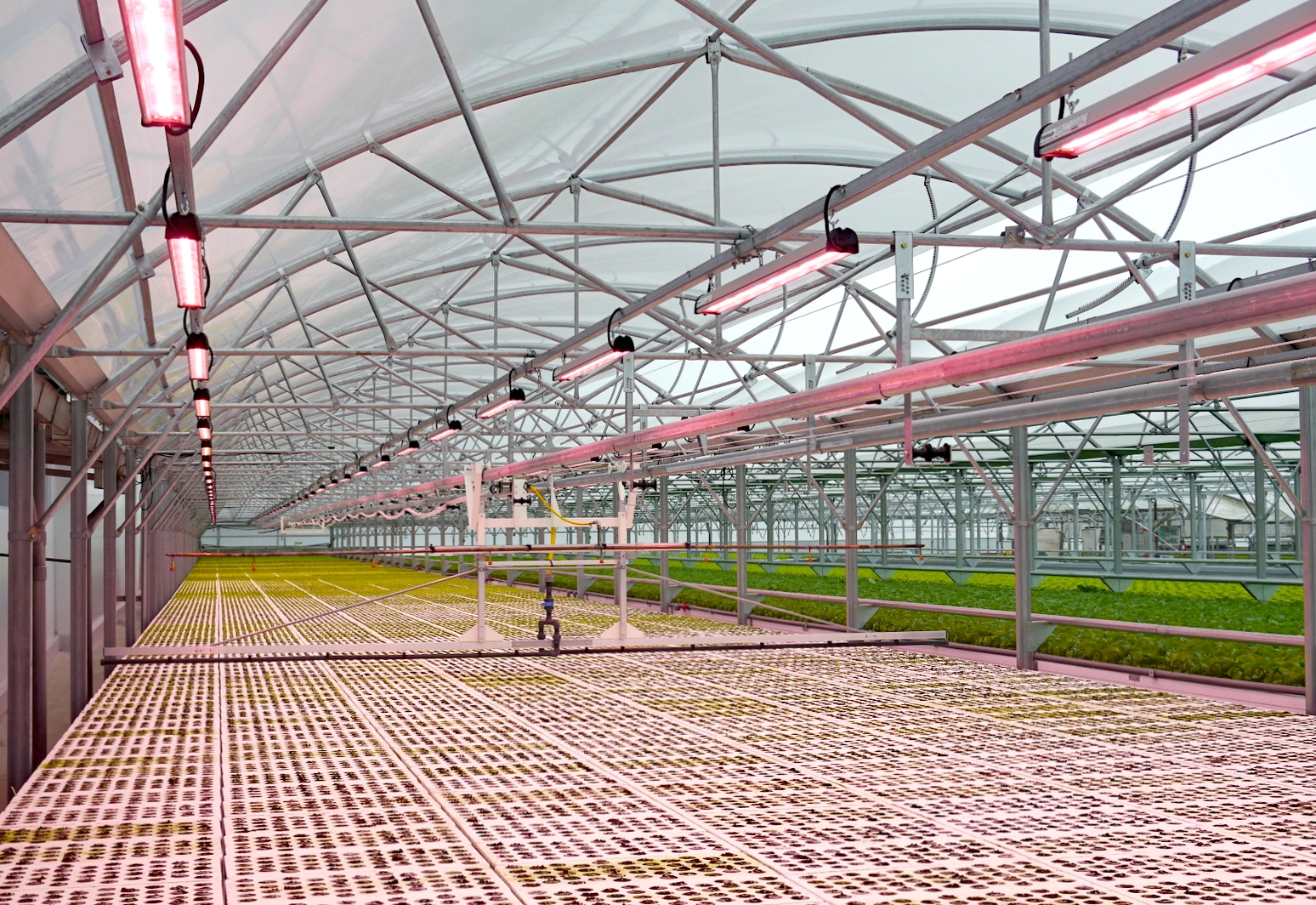
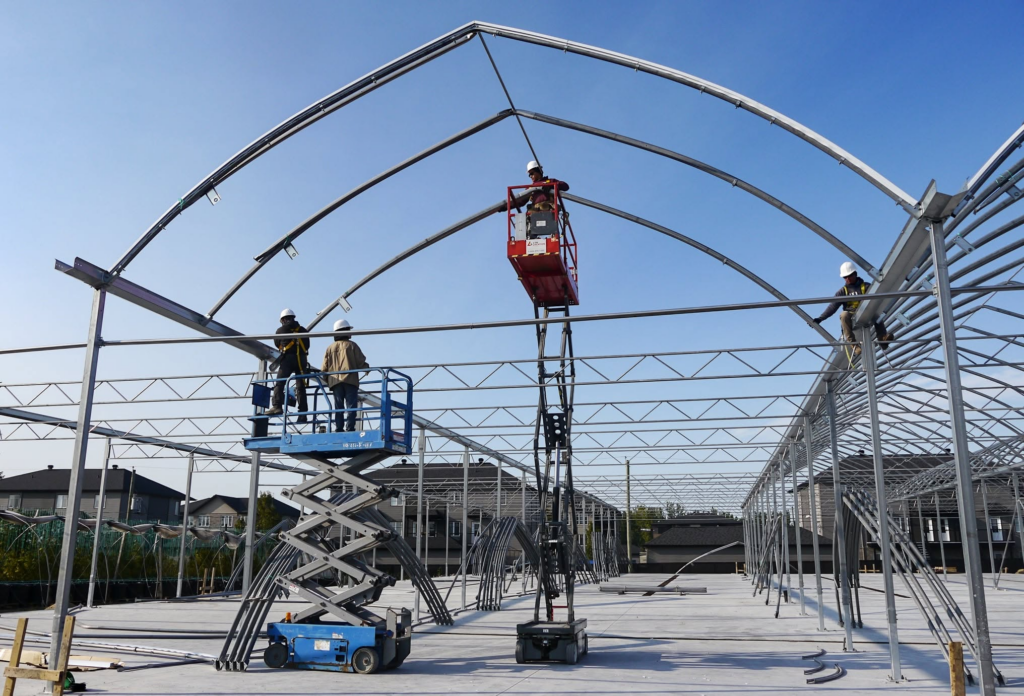
Every member that crosses the roof casts a shadow. So every decision about bracing, arch spacing, and steel section is also a yield decision. The structure is not a passive shelter. It is an agronomic tool. Savard frames the same idea from the engineering side. Rather than crowding the roof with extra bracing, his team designs thicker or larger structural sections to keep the roof open. Strength goes up. Shading does not. Light transmission and climate management drive the crop, and the frame is where that fight is won or lost.
Designing for the load, not the average
Snow and wind are the governing loads on any greenhouse. They are also the loads that put both crops and capital at risk in a single event. The greenhouse-specific standard EN 13031-1 exists precisely because these structures are lightweight and load-sensitive, with dedicated rules for wind actions, snow actions, and the behaviour of arches under stress.
The failure pattern is well documented. Finite-element analysis of pipe-framed greenhouses under snow shows that collapse tends to begin where bending moments concentrate, at a single yielding member, rather than evenly across the frame (Shen et al., 2025). A design tuned to an average winter misses the event that actually breaks the structure. Savard describes a process built to avoid exactly that.
We assess the site exposure, the surrounding terrain, and neighbouring structures. An open field means higher wind pressure. A greenhouse near tall buildings might experience snow accumulation from drifting. Every case of loading and every required code combination is accounted for.
Carl Savard, P.Eng.
Climate adaptation means designing for extremes that are becoming normal
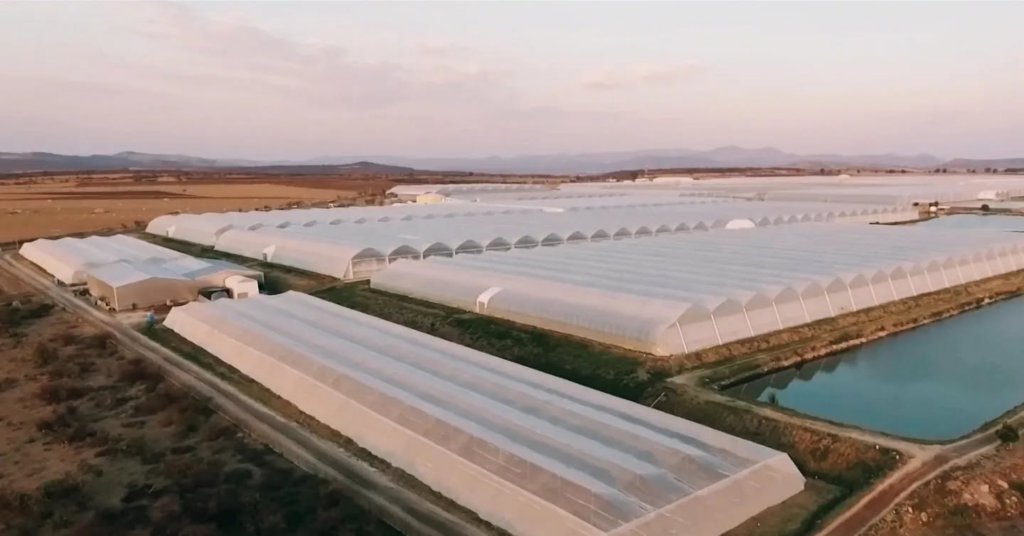
Extreme weather is no longer the exception. Structural research is now explicit on this point. The rising frequency and intensity of heavy snowfall under a changing climate raises the failure risk for lightweight agricultural structures, which forces a rethink of the characteristic loads used in design (Cold Regions Science and Technology, 2022). Designing for climate adaptation therefore means anticipating stress rather than reacting to it.
In North America, every structure already has to satisfy regional load codes, the National Building Code of Canada and ASCE 7 in the United States, and those codes keep tightening. The harder problem, Savard notes, appears on expansion. When a new bay is added to an older greenhouse that no longer meets current code, the new sections should be engineered so they do not share structural loads with the old frame. That single design rule protects the existing investment and keeps the operation running during the work.
Strength and light are one problem, not a trade-off
There is a lazy way to add strength and a #RightTech way. The lazy way reduces arch spacing or piles on bracing. Both steal light, and both cost yield every day for the life of the greenhouse. The rigorous way solves for strength and transparency at the same time, by adapting the steel sections where load demands it and leaving the roof open everywhere else.
Ventilation follows the same logic. Taller structures exchange air more effectively and hold temperature more evenly. Post sizing is matched to the number of spans so that stability and climate balance improve together. None of this is decoration. Less shading, better airflow, and a stable frame are agronomic outcomes delivered through engineering choices made long before the first crop goes in.
Engineering that travels beyond farming
The same principles hold well outside vegetable production. Savard points to a reinforced gutter-connected conservatory in the Florida Keys that has come through several Category 5 hurricanes without structural damage. It is a useful reminder. A structure engineered for its worst credible event, not its average day, is what keeps the doors open when the weather turns.
The takeaway for growers
Climate-adapted greenhouse design is not a finish applied to a catalogue frame. It is a site-specific engineering decision that precedes every technology purchase you will make. Get the envelope right, and light, airflow, and the load path all end up working for the crop. Get it wrong, and no climate computer will save the season. That is #RightTech in practice. The structure comes first, and the technology it can support comes second.
References
Marcelis, L.F.M., Broekhuijsen, A.G.M., Meinen, E., Nijs, E.M.F.M., Raaphorst, M.G.M. (2006). Quantification of the growth response to light quantity of greenhouse grown crops. Acta Horticulturae 711, 97-103. doi.org/10.17660/ActaHortic.2006.711.9
CEN (2019). EN 13031-1:2019 Greenhouses. Design and construction. Part 1: Commercial production greenhouses. standards.iteh.ai
Shen, J., Jiang, Y., Zhu, L. et al. (2025). Failure mechanisms and reinforcement of pipe-framed solar greenhouses under snow loads. Scientific Reports 15. nature.com/articles/s41598-025-01186-w
Analysis of ground snow load for greenhouse structures in Croatia (2022). Cold Regions Science and Technology. sciencedirect.com