
This post is also available in:  English
  Français (French)
  Español (Spanish)
Pandemic, Energy, Climate, Labor shortage and Markets: Key Takeaways from Six Years in the North-American Greenhouse Industry
After six years in the North American greenhouse industry, this article offers an in-depth perspective on the evolution of the greenhouse industry between 2020 and 2025. From pandemic disruption to energy and inflation headwinds, and from labor challenges to technological adaptation, we examine how producers and industry partners have navigated a rapidly changing landscape.
Drawn from on-the-ground experience across Canada, the United States, and Central America, this analysis highlights the key forces shaping the future of controlled environment agriculture (CEA).
2020 — New Climate, New Reality
In early 2020, shortly after arriving in Québec to begin a new professional chapter with Industries Harnois, the world was thrust into the Covid-19 pandemic. Initially, uncertainty dominated: travel came to a halt, projects were postponed, and questions swirled about what the future held for the greenhouse sector.
Paradoxically, the pandemic became a major catalyst for greenhouse production. In Québec, public policy support aimed at food autonomy accelerated investment in protected agriculture. Across Canada and the United States, travel restrictions and changing consumer habits drove strong demand for both ornamental plants and local food production.
The greenhouse quickly became not just a production tool, but strategic infrastructure capable of responding to multiple systemic pressures.
2021 — Expansion and Emerging Complexity
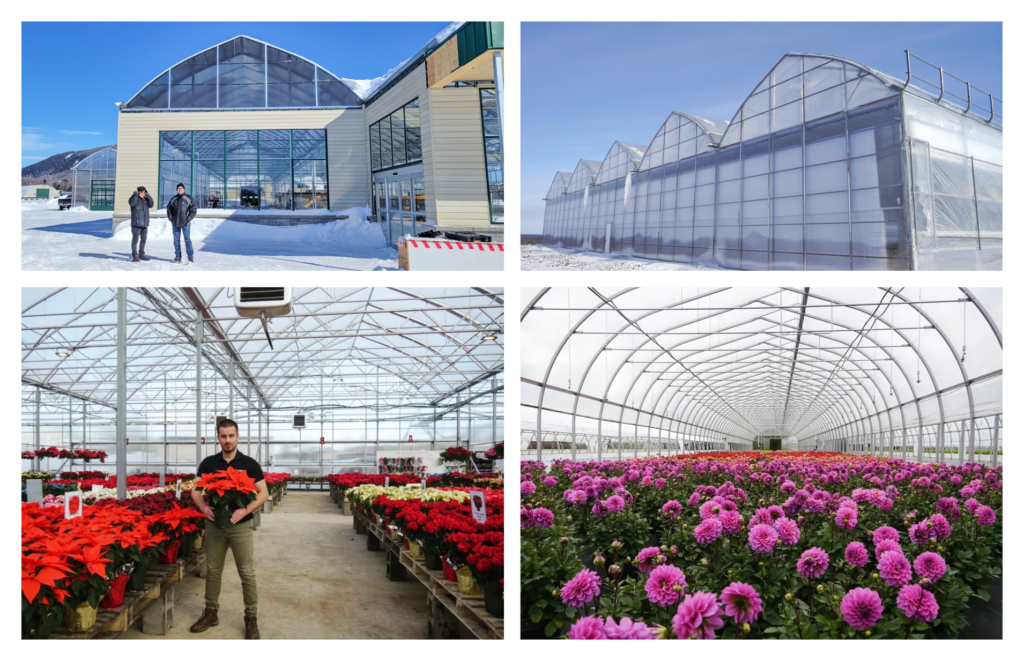
As travel resumed in 2021, activity on the ground accelerated significantly. Growers expanded capacity rapidly, and new greenhouse installations outpaced the industry’s ability to meet demand. At Industries Harnois, sales of greenhouse structures (at this time especially plastic-covered greenhouses for floriculture and vegetable production) exceeded our production capacity at times.
This intense growth underscored two realities of the North American market: strong producer willingness to invest and consequential pressure on supply chains and lead times. Regional distribution networks combining technical horticultural expertise and local service became critical in supporting growers through this expansion phase.
2022 — Economic Constraints and Broader Exposure
As the post-pandemic recovery unfolded, new headwinds quickly emerged. Inflation resurfaced, interest rates climbed, and cost pressures intensified across the economy. Consumer spending on ornamentals softened noticeably, while lower-cost imports from Mexico and other parts of Latin America gained market share, particularly in vine crops such as tomatoes, bell peppers, and chili peppers.
This trend was not unique to North America. In Europe’s ornamental sector, production was projected to fall significantly, reflecting similar cost and demand pressures globally.
During this year, I also supported the export development efforts of Industries Harnois, participating in early greenhouse projects in Guatemala with one of Central America’s largest lettuce producers. This marked the beginning of a fruitful collaboration linking North American greenhouse expertise with producers in warmer climates, diversifying markets beyond traditional territory.
2023 — Market Adjustment and Strategic Repositioning
The greenhouse industry faced considerable challenges in 2023. High operational costs (particularly heating costs in colder climates) weighed heavily on producers. In many operations in Québec, heating can account for more than one-third of total operating expenses. After a surge in construction between 2020 and 2022, the market entered a period of normalization and slower growth, reflecting a cyclical adjustment in demand.
In addition to these economic pressures, a persistent labor shortage significantly affected greenhouse operations. This structural constraint reinforced interest in optimizing existing facilities and accelerated consideration of semi-automation. Rather than being a technology fad, automation became a pragmatic lever to secure operations and reduce dependence on scarce labor, particularly for repetitive or labor-intensive tasks.
Within this context, my role expanded at Industries Harnois to lead sales and business development, including in the Québec market. This shift allowed me to focus on adapting our offerings to the new environment and to identify opportunities aligned with evolving producer needs.
The introduction of high-tunnel solutions, such as the TunnelPro Plus, reflected this practical shift: cost-effective, resilient structures that enhance climate resilience while offering an accessible entry point for growers. The summer of 2023, marked by widespread flooding, underscored the vulnerability of open-field production and further validated the value of protected structures.
More broadly, greenhouses are playing an increasingly important role in improving the management of production inputs, particularly water and fertilizers. Precise environmental control allows growers to optimize inputs, reduce losses, and gradually limit reliance on crop protection products, whose costs have risen significantly since 2020. This approach not only enhances operational efficiency, but also lowers the environmental footprint of greenhouse production, supporting greater social acceptance and higher product quality for consumers.
At the same time, greenhouse development continued in Central America and the Caribbean, including hurricane-resilient installations for producers in exposed regions such as Bermuda. The strength of these structures, combined with thoughtful engineering and agronomic design, became key differentiators in global markets.
The cannabis sector in Canada experienced a notable slowdown in Canada, while the U.S. market remained heterogeneous, shaped by state-by-state legalization patterns.
2024 — Converging Models and Flagship Projects
The year 2024 brought clearer signs of recovery. Interest in “smart low-tech” solutions remained strong, often enriched by targeted innovations from the Harnois engineering team. At the same time, specialized segments such as forest nurseries gained traction, relying on precise climate control and semi-automated systems to produce specific tree species.
This period also saw the realization of high-tech projects integrating advanced automation, optimized energy management, and refined climate control. These installations demonstrated that industrial rigor could coexist with long-term agronomic vision. These projects integrate major advances in climate control, energy efficiency, and operational streamlining, particularly for cleaning and harvesting processes within the facilities, demonstrating that industrial rigor can coexist with a long-term agronomic vision.
On a personal level, 2024 marked the launch of a specialized newsletter Horti-Gen Insights through Ag Tech Media News and the Horti-Generation blog, aimed at biweekly insights into greenhouse and ag-tech trends.
2025 — Consolidation, Resilience, and Long-Term Vision
The momentum continued in 2025. Segments such as ornamentals showed renewed activity in Canada, supported by targeted public funding that boosted high-tunnel projects, particularly for crops like strawberries and raspberries. Product lines such as Ovaltech and Luminosa grew in popularity, helping expand market share.
Early in the year, U.S. government tariffs on Canadian steel and aluminum created new headwinds for greenhouse exports. Despite this, currency movements and rising U.S. material costs helped Canadian manufacturers (including Harnois) remain competitive by focusing on adaptability and value.
On a personal standpoint, 2025 was a dynamic year with a diverse portfolio of projects across Canada, the United States, and Guatemala. Late-year project commitments provided solid visibility into 2026, even as geopolitical and trade pressures continued to evolve.
Conclusion — The Future of the North American Greenhouse Industry
These six years in North America reinforce a clear conviction: the future of the greenhouse industry lies not in a divide between high-tech and low-tech solutions, but in their intelligent convergence. Beyond structures and equipment, long-term success increasingly depends on aligning human expertise, technology, and operational culture.
As climate, energy, labor, environmental, and geopolitical pressures intersect, greenhouses have become essential infrastructure within Controlled Environment Agriculture. They serve as the foundation of integrated production systems, enabling greater resource efficiency, resilience, and predictability. Positioned at the earliest stage of project development, greenhouses also play a strategic role in building durable partnerships with growers and supporting the broader transformation of agriculture toward more sustainable, high-performance models.

Connect with me

Complementary sources:
Corenthin (Felix) Chassouant new director of sales and business development at Harnois:
https://www.hortidaily.com/article/9557020/corenthin-felix-chassouant-new-director-of-sales-and-business-development-at-harnois/
Harnois Greenhouses & Dubois Agrinovation Partner to Deliver Turnkey Solutions:
https://igrownews.com/harnois-greenhouses-latest-news/
High technology greenhouses: Improving tree nurseries efficiency: https://harnoisgreenhouse.com/high-tech-greenhouse-systems-for-tree-nurseries/
South-East Asian and North-American horticulture can learn a lot from each other:
https://www.hortidaily.com/article/9287446/south-east-asian-and-north-american-horticulture-can-learn-a-lot-from-each-other/
Vegpro international to build $135M greenhouse:
https://thegrower.org/news/vegpro-international-build-135m-greenhouse


[…] North American Greenhouse Industry Review: Trends, Resilience, and Transformation (2020–2025) agriculture contrôlée rentable Break-even point cea CEA profitabilité CEAprofitability CommercialGreenhouse ControlledEnvironmentAgriculture Cruising speed culture en serre démarrer une serre GreenhouseGrowing HorticultureBusiness NorthAmericaCEA producteur en serre Canada producteur en serre CanadaCEA profitabilité production hydroponique commerciale rentabilité serre commerciale RighTech vitesse de croisière production CEA […]