
This post is also available in:  English
  Français (French)
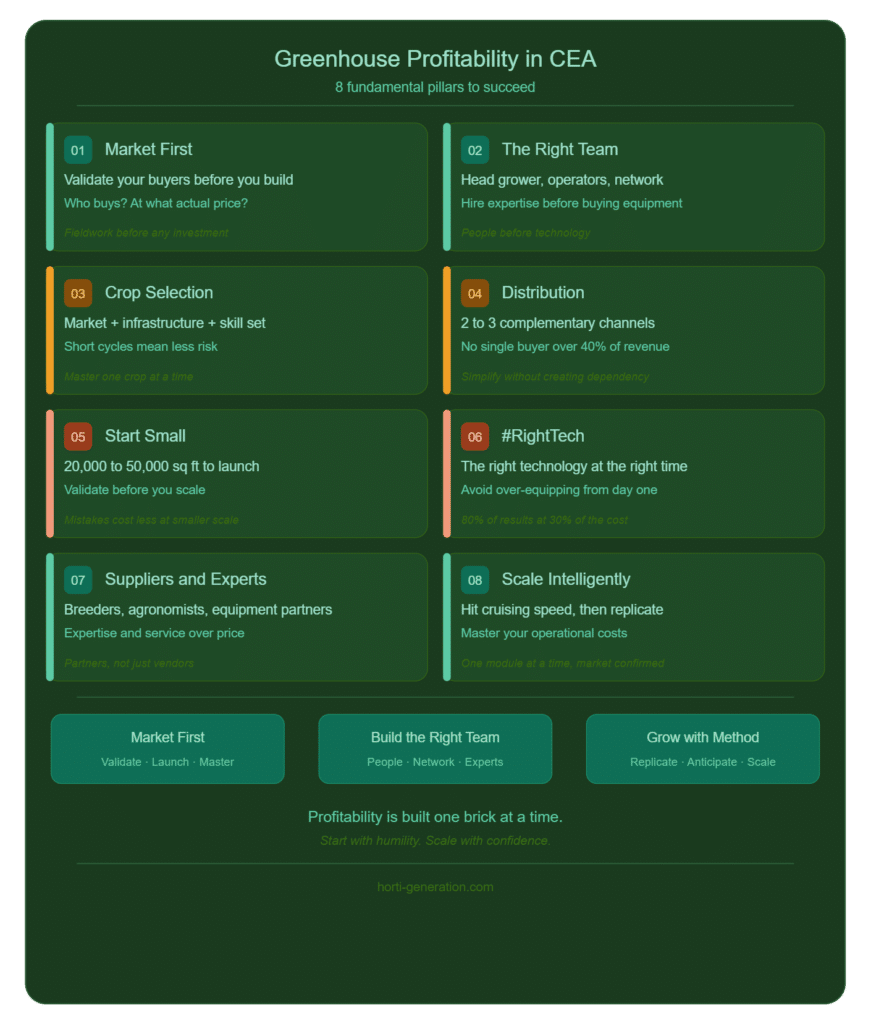
Too many growers build their greenhouse, fill their rows, and then start looking for buyers. That’s where things fall apart. Profitability in controlled environment agriculture isn’t about finding the perfect technology or the trendiest crop. It’s about making the right decisions, in the right order. Here are the eight pillars that separate thriving operations from those that struggle to survive.
In this article, we’ll explore the eight pillars that distinguish successful businesses from those that fail.
1. Know Your Market Before You Plant a Single Seed
Picture this: you invest $500,000 in a state-of-the-art facility, and six months later, you discover that the price growers actually get paid in your region doesn’t cover your production costs. This scenario plays out more often than anyone in the industry wants to admit.
Before you sketch a single floor plan, answer these questions: Who are your potential buyers? Independent grocers, regional chains, restaurants, farmers markets, CSA boxes? What price is actually paid to the grower in your area, not the retail shelf price, but what lands in your pocket after the truck pulls away? And who are your local competitors, what are they offering, and where are the gaps?
These answers don’t come from a market research report. They come from showing up: walking the farmers’ markets, sitting down with produce buyers, calling distributors. Those conversations are worth more than any generic industry study, and they need to happen before a single dollar is spent on infrastructure.
2. Build the Right Team: People Before Equipment
A greenhouse is a living system. It doesn’t tolerate inattention or prolonged incompetence.
Your head grower is your first investment. If you’re not a trained horticulturist yourself, hire that expertise before you buy a single piece of equipment. This person manages plant health, fertigation, and integrated pest management (IPM) = the engine of your entire operation. No automation system replaces that trained eye.
Document your protocols. Train your crew to understand why they do what they do, not just how. And plug into the professional networks in your region: organizations like AmericanHort, the Ohio State University, the Controlled Environment Agriculture Center (CEAC) at the University of Arizona, or state-level greenhouse grower associations. The best practices and the best people move through these networks.
3. Choose the Right Crop
There’s no such thing as a universally profitable crop. The right crop sits at the intersection of your target market, your infrastructure, and your technical skill set.
In North American CEA, it helps to think in three distinct categories. Fruiting crops, tomatoes (cluster, grape, beefsteak), and English cucumbers in particular, represent the most established and mature market, but they demand solid infrastructure and serious agronomic expertise. Leafy greens (lettuce, basil, spinach, arugula) are often the smartest entry point for new growers: short cycles, fast turnover, and lower agronomic complexity. Peppers command strong prices but require tighter technical management. Specialty crops (microgreens, strawberries, mushrooms) open high-value niches, but markets are limited and demand is less predictable.
One angle that’s easy to overlook: short-cycle crops also carry less risk at startup. A faster turn means less exposure time to pests and disease pressure, and if something goes wrong, you can correct course in weeks, not months.
Beyond crop selection, you need to consistently deliver volume and uniform quality. Large buyers, especially grocery chains and regional distributors, run on predictability. Same size, same color, same freshness, week after week. An irregular delivery or an off-spec load can cost you a contract that took months to close. Before targeting those channels, make sure your operation can hold up that commitment.
The fundamental rule: master one crop before introducing a second. Every species has its own climate, nutrition, and pest management requirements. Premature diversification is a direct path to losses.
4. Build Your Distribution Model — Simplify Without Creating Dependency
Growing is only half the job. How does your product get to the consumer?
Target two to three complementary channels: for example, a regional distributor for baseline volume, independent natural grocers for margin, and a farmers market for brand visibility. Too many channels create operational complexity. A single channel creates a dangerous dependency, and if that buyer walks away, your cash flow collapses with it.
“No single customer should represent more than 40% of your revenue.”
Corenthin Flix Chassouant
Negotiate supply agreements with guaranteed minimum volumes. A 12-month commitment gives you a production schedule and a cash flow forecast, two things that make everything else more manageable.
5. Don’t Start Too Big
This is the most expensive mistake in CEA, and it’s the most common. An enthusiastic operator raises capital, builds a 100,000- 200,000 sqft (or 1-2 ha in surface) facility on day one, and, six months later, finds themselves crushed by fixed costs while the team is still learning the basics on an oversized infrastructure.
Starting small is a strategic advantage:
- Mistakes cost less at a smaller scale
- You validate your market before you’re overcommitted
- You build your operational protocols without the pressure of massive overhead
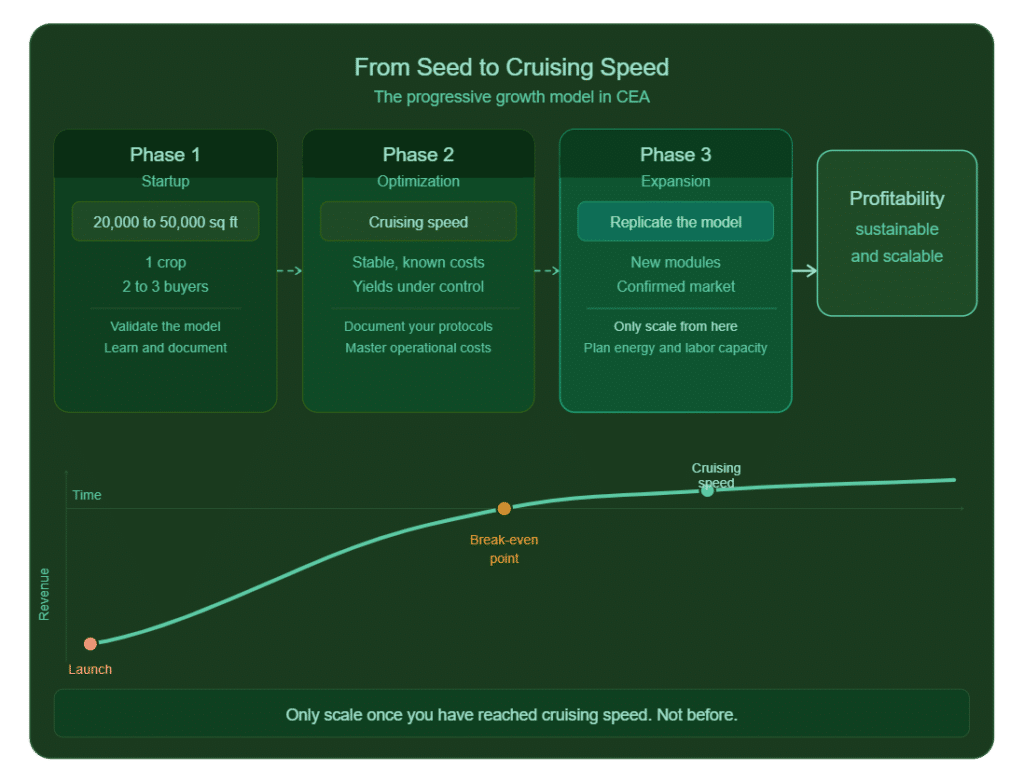
For a commercial CEA vegetable operation, 20,000 to 50,000 sq ft (or 2000 to 5000m2) is a realistic starting range: large enough to generate meaningful revenue, small enough to stay nimble and correct course quickly.
6. Choose the Right Technology — The #RightTech
In greenhouse production, technology exists on a wide spectrum, from low-tech (unheated structures, natural ventilation, manual irrigation) to high-tech (glass Venlo greenhouses, full automation, harvest robots, real-time IoT platforms). Between those two extremes sits mid-tech, the most realistic and profitable entry point for most new commercial operators.
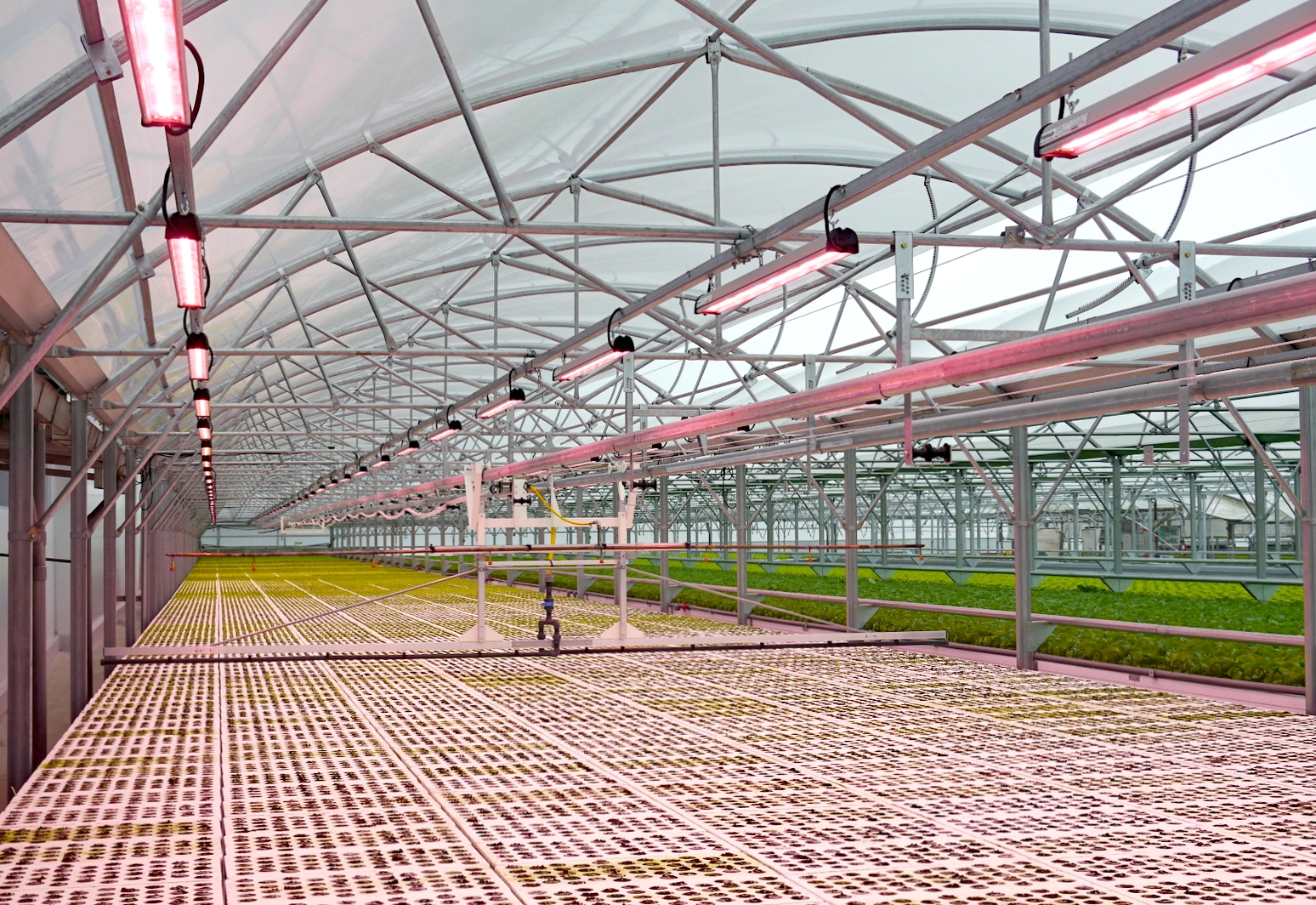
Take supplemental LED lighting as a concrete example. Many lighting companies will aggressively pitch full-facility conversions with premium fixtures that can sometimes cost more per square foot than the greenhouse structure itself. It’s worth asking honestly: is that level of investment truly necessary at the startup stage? Supplemental lighting is a powerful tool, but the ROI only makes sense once your operation is dialed in and your baseline costs are under control. Add to that the installation cost and the significant jump in energy consumption it brings to your monthly overhead, and you start to see why LED lighting is best treated as a Phase 2 or Phase 3 upgrade rather than a day-one requirement.
In fact, this article is primarily aimed at mid-scale projects: double-poly structures (LUMINOSA type) equipped at a minimum with a climate computer, horizontal airflow fans (HAF), shade and thermal screens, and a precision fertigation system. This baseline gives you meaningful environmental control without the capital intensity of large glass operations. That said, the same #RightTech logic applies to growers launching larger projects — the principle is universal.
Some vendors will push you toward additional layers of sophisticated automation, harvest robotics, and IoT platforms. It’s all impressive, and most of it is premature at startup. An over-equipped system means an initial investment that drags on profitability for years, a steeper learning curve for your crew, and dependence on expensive outside technicians.
Before any technology purchase, ask yourself:
- Does this solve a real problem I have right now?
- Can my team operate and troubleshoot it without calling the vendor?
- Is there a simpler solution at 30% of the cost that delivers 80% of the result?
There’s also smart money to be spent in the middle ground. A well-dimensioned greenhouse with generous air volume naturally reduces dependence on forced mechanical ventilation. Semi-automated systems, such as mobile growing trays that can be moved with standard equipment (Blackmore’s Air Trays are a strong example), can dramatically improve labor efficiency without a multi-million-dollar investment. These are the kinds of targeted decisions that define the #RightTech mindset.
The winning strategy: start mid-tech, get to cruising speed, then invest progressively in equipment that sharpens your margins. Supplemental lighting, more sophisticated environmental sensors, and real-time monitoring platforms; these upgrades deliver far more impact when your operation is already running well than when you’re still finding your footing.
On the agronomic side, substrate formulation and seed selection are two levers that are consistently underutilized. A growing medium better matched to your specific crop, water quality, and climate can meaningfully improve nutrient uptake and cut waste. And choosing the right varieties, not just for yield but for uniformity, post-harvest shelf life, and regional disease resistance, can add margin points without adding a single piece of equipment.
7. Surround Yourself with the Right Partners
Your supplier network is as strategic as your internal team.
On the seed side, variety selection is both an agronomic and a commercial decision. A tomato variety with strong Botrytis resistance in your climate can be the difference between a profitable season and a disaster. Work with breeders who know the North American CEA market (Rijk Zwaan, De Ruiter, Enza Zaden, Syngenta Vegetables, Voltz Maraîchage, Limagrain/HM Clause…) and always request trial data before committing to a variety at commercial scale.
On the consulting side, a greenhouse-specialized agronomist, not a field crop advisor, can save you from nutrition errors or pest management mistakes that would cost far more than their fee.
On the equipment side, evaluate your suppliers like long-term partners: after-sales service, emergency availability, depth of knowledge about your specific crop. Price is one factor among many, and rarely the most important one.
8. Hit Cruising Speed First, Then Scale Intelligently
Profitability isn’t a destination you reach once. It’s a dynamic balance you have to find, document, and then replicate.
You’ve hit cruising speed when your cost of production per pound is stable and known, your markets are consistent, your team operates with confidence and low waste, and your cash flow is predictable 6 to 12 months out. This is where the game is really won: mastery of operational costs is what separates a healthy greenhouse from one that’s always on the edge, far more than the volume produced or the sophistication of the equipment.
Don’t scale until you’ve hit that equilibrium. Scaling too early multiplies unresolved problems. Scaling at the right time means replicating a working model, one module at a time.
Before any expansion, stress-test your external parameters: Can your energy contract support 2x consumption? Is there enough qualified labor in your region to staff a larger operation? Do your current or future buyers have the capacity to absorb the added volume?
A veteran grower who built one of the most consistently profitable operations in Southeast Asia, I’ve worked with, put it this way:
“A person has to have enough practical skill sets and plant knowledge to stand in and run most parts of the system in the absence of key people. Part of de-risking is not being over dependent on others. Additional contingency capital is a must for cash flow issues.”
That’s hard-earned wisdom that no business plan template will ever teach you.
Bottom line
The most profitable greenhouse isn’t the one that starts fastest or spends the most. It’s the one that executes in the right sequence: validate the market, build a strong team, master one crop, then grow only once the model has proven itself. Every disciplined decision you make today is a crisis you avoid tomorrow.
Planning your first commercial greenhouse or looking to sharpen an existing operation? The Horti-Generation community is here to help you build something that lasts. Contact us.
Go Further
For a broader market perspective, see our North American Greenhouse Industry Review.



[…] Greenhouse Profitability: 8 Pillars to Succeed in Controlled Environment Agriculture (CEA)5 Mistakes to Avoid When Starting a Hydroponic Greenhouse for Leafy Greens in North AmericaMid-tech leafy-greens & herbs greenhouse system in Central-America CEA investment CommercialGreenhouse greenhouse construction cost mid-tech greenhouse cost NorthAmericaCEA RightTech […]
[…] Greenhouse Profitability: 8 Pillars to Succeed in Controlled Environment Agriculture (CEA) […]