
This post is also available in:  English
  Français (French)
Every week, a grower somewhere signs a contract for a greenhouse that is either too sophisticated for their market or too limited for their crop. Both decisions are expensive. This article provides a practical agronomic framework to make the right decision.
The question is not “what is the best greenhouse?” The question is “what is the right greenhouse for this crop, this market, this team, and this budget?” Those are very different questions, and confusing them is one of the most common and most costly mistakes in commercial horticulture today.
As an agronomist, I have seen this pattern repeatedly: a grower invests in high-tech infrastructure before validating their agronomic protocol, or conversely, builds a low-cost tunnel that cannot maintain the environmental conditions their crop requires to be commercially viable. Neither path leads to profitability. The right technology level emerges from a clear-eyed assessment of agronomic requirements first, then market and financial realities.
Why agronomic requirements come before technology decisions
Technology in a greenhouse serves one purpose: to maintain the environmental conditions your crop needs to grow at a commercially viable rate. That sentence sounds obvious. In practice, it is frequently inverted. Growers choose a technology level based on what they can afford or what impresses investors, and then try to adapt their crop choice to fit the infrastructure.
The correct sequence is the reverse. You start with the crop. You identify the minimum environmental requirements for that crop to produce commercially acceptable quality and yield. Then, and only then, do you ask what level of infrastructure is required to reliably maintain those conditions at your specific location.
A strawberry grower extending their season in Ontario needs a very different infrastructure than a year-round tomato producer supplying a national retail chain. Both are legitimate businesses. Both require the right-sized tool.
Agronomist’s note: The most common over-investment pattern I observe is growers installing supplemental LED lighting before they have validated their agronomic protocol and established stable production costs. LED lighting has a real ROI story, but only once you know exactly what your base yield and product quality look like without it. Layer technologies onto a proven agronomic baseline, not onto aspirations.
The three greenhouse technology tiers for North American producers
Low-tech: high tunnels and season-extension structures
Field-scale high tunnels or hoop houses, single-layer poly structures, occupy a legitimate and valuable position in the North American growing landscape. These structures are not inferior greenhouses; they are purpose-built tools for a specific and well-defined production model.
In most northern regions, low-tech tunnels are three-season structures. The poly covering is removed before winter and reinstalled in late winter or early spring. This is not a limitation to work around; it is a design reality to plan for when choosing this technology tier. The structure itself must be winterised properly each year, and the annual installation and removal cycle needs to be factored into your labour planning.
The core commercial advantage of a high tunnel is season extension. By getting your crop in the ground two to four weeks earlier than open-field competitors, you access the spring market window when local product is scarce, and premiums are highest. For strawberries, raspberries, and early-season vegetables, that timing advantage translates directly into price and sell-through. You are not competing on volume or year-round availability; you are competing on earliness, local origin, and freshness at a time when the market rewards all three.
For producers already farming outdoor fields, a field-scale high tunnel is often the most capital-efficient first step into protected cultivation. It extends your existing season, protects a high-value crop from weather variability, and generates a quick return without committing to the heating infrastructure and year-round operating costs of a climate-controlled greenhouse.
Mid-tech: double-poly gutter-connected structures
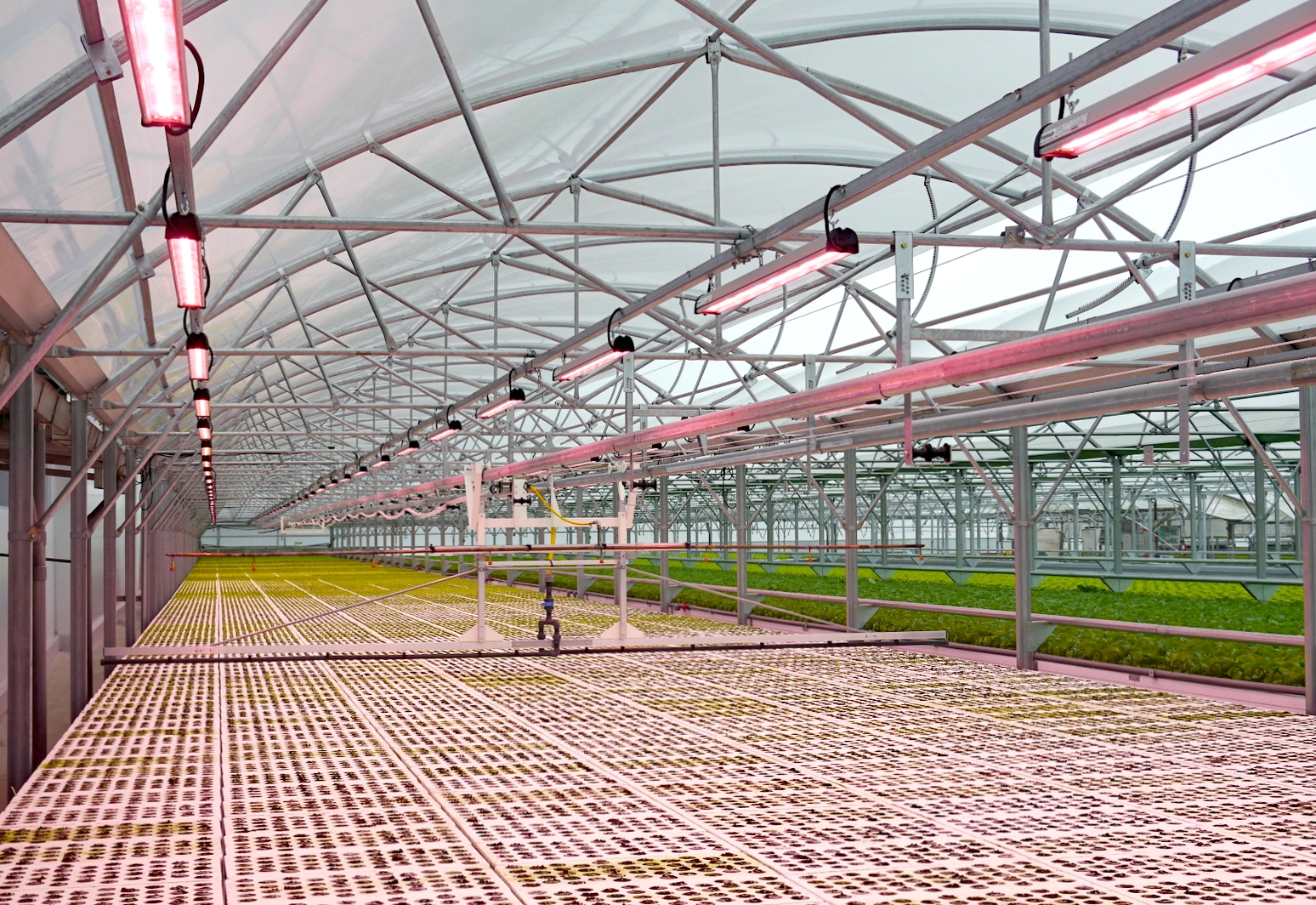
The double-poly gutter-connected greenhouse is the workhorse of the North American commercial greenhouse industry and represents what this blog calls the #RightTech sweet spot for most new and expanding commercial operations. It delivers meaningful environmental control, including year-round production capacity, precise heating, humidity control, shading, and thermal screening, without the capital intensity of glass or the operating risk of extremely sophisticated automated systems.
The double-poly inflation system is one of the most underappreciated technologies in the greenhouse world. Two layers of polyethene film with a continuous air space between them deliver a thermal efficiency improvement of nearly 55 per cent compared to single-glazed glass, based on the difference in heat transfer coefficient between single glass (6.2 W/m²·°C) and thermal-treated double-inflated polyethene (2.8 W/m²·°C), and at a fraction of the capital cost of glass or rigid double-wall polycarbonate. For a detailed breakdown of covering materials and heat loss mechanisms, see our dedicated article on greenhouse insulation. In northern climates where heating costs account for a major share of operating expenses (>30%), this is a structural advantage that compounds over decades.
At this technology tier, your environmental control toolkit includes horizontal airflow fans (HAF) for climate uniformity, an entry-level to mid-range climate computer for managing temperature and humidity, a thermal screening system for summer shading and winter heat retention, and a properly sized heating system. These four systems, correctly specified and operated, give an experienced grower the tools to produce commercially competitive crops in virtually all North American growing regions.
Voici le code SVG de la Figure 2 à coller dans un bloc HTML personnalisé dans WordPress : htmlHigh-tech: glass and fully automated structures
Glass greenhouse production at scale, with full supplemental LED lighting, CO2 enrichment, and full automated harvesting systems, is a legitimate industrial production model. It is also a capital-intensive model that requires a very specific set of conditions to generate an acceptable return on investment: a confirmed high-volume market relationship with a retail or foodservice buyer, a head grower with significant experience operating sophisticated climate systems, robust financing capacity, and typically a minimum production scale that justifies the fixed overhead of the technology stack.
The failures of several high-profile CEA companies in recent years are instructive here. The technology in those facilities was often excellent. The business model assumptions were not. A grower who cannot meet their production volume at prices sufficient to cover their infrastructure costs will fail at any technology level; the higher the infrastructure costs, the less margin for error, especially in North America, where climate conditions can be extreme, and energy costs are volatile.
Key principle: High-tech infrastructure does not compensate for a missing or unvalidated market. If you cannot confirm who will buy your product, at what price, and at what volume before you build, the technology level is not your first problem to solve.
The five questions that determine your right technology level
Before committing to any greenhouse structure, every producer, whether new or expanding, should be able to answer these five questions with specificity.
Agronomic performance before technology performance
This is the principle that most technology-focused greenhouse discussions skip, and it is where an agronomic perspective fundamentally changes the conversation. Technology is a means of delivering environmental conditions. The agronomic protocol is what converts those conditions into a marketable product.
A producer who has a precise, validated production protocol, who knows their target day and night temperatures by crop stage, their optimal vapour pressure deficit range, their nutrient solution EC and pH targets, their transplant timing, and their expected crop cycle duration, will get significantly more out of a mid-tech structure than a producer running an unclear agronomic program in a high-tech facility.
This is not a theoretical argument. It is the single most consistent observation from 20 years+ of commercial greenhouse development across North America, Europe, and other regions. Agronomic competence outperforms infrastructure investment at every technology level.
The sequencing principle: Establish your agronomic baseline first. Validate your protocol across at least one full production cycle. Document your per-unit production cost at stable throughput. Only then does a decision about technology upgrades, supplemental lighting, CO2 enrichment, advanced sensors, have a sound financial basis.
Where the low-tech tunnel fits the North American market
Large tunnel structures serve a specific and growing market in North America: producers who want to extend their outdoor growing season, protect high-value berry crops from weather variability, and access premium local market pricing without committing to year-round heated production infrastructure.
For strawberry, raspberry, and blackberry production in particular, the economics of a large-format tunnel can be very compelling. The capital cost is substantially lower than that of a climate-controlled greenhouse. The operating cost profile is simpler. The crop cycle is seasonal, which aligns naturally with the market timing premium for local berries in spring and early summer.
One of the key distinctions of this technology tier is that high tunnels are not engineered structures. Unlike commercial freestanding or gutter-connected greenhouses, they do not require a professional engineer’s stamp for construction. This keeps costs low and simplifies the permitting process, but it also means the structural margin for error is narrower. Wind loading is the primary risk. A tunnel that is not properly anchored or that is positioned on an exposed site without adequate windbreak protection is vulnerable to partial or total loss in a severe wind event. Selecting a quality structure and installing it according to the manufacturer’s specifications is not optional.
Beyond wind, three other damage mechanisms deserve attention before you build. First, freeze-thaw cycles: repeated expansion and contraction of the soil and foundation anchors over the course of a northern winter progressively loosen the structure and can compromise its integrity by the time you reinstall the poly in spring. A proper inspection and re-tensioning protocol at the start of each season is good practice. Second, chemical exposure: the polyethene covering and the metallic frame are both susceptible to degradation from pesticide and fertiliser applications, particularly with lower-quality structures where the steel galvanisation or the poly formulation is thinner. Always verify chemical compatibility before applying anything inside or near the tunnel, and prioritise structures with a robust galvanisation standard. Third, the poly removal and reinstallation cycle itself introduces mechanical stress each year. Handling, folding, and storage practices matter, and a torn or UV-degraded poly that fails mid-season is a crop protection problem with no quick fix.
The limitation of tunnel production remains equally important to understand: you do not have the environmental control to run year-round vine crop production at a commercial scale, and you cannot reliably achieve the temperature consistency that premium leafy green buyers expect on a twelve-month supply contract. Know your market and match your structure to it.
Technology tier comparison: a reference for North American producers
| Criteria | Low-tech tunnel | Mid-tech double poly | High-tech glass |
|---|---|---|---|
| Production season | 3-season / extension | Year-round | Year-round |
| Climate control | Low — passive ventilation | High — active systems | Very high — full automation |
| Capital cost CAD/sq ft | Under $40 | $65 to $120 | Over $250 |
| Engineer stamp | No | Yes | Yes |
| Structural risk | Wind, freeze-thaw, chemicals | Snow load, wind load | Snow load, wind load |
| Best crop fit | Berries, seasonal vegetables | Leafy greens, vine crops | High-volume tomatoes, premium greens |
| Team skills | Low to moderate | Moderate | High — experienced head grower |
| Energy intensity | Very low | Moderate | High |
| Market | Local, seasonal premium | Local to regional year-round | Confirmed retail or foodservice volume |
| © Horti-Generation 2026 · horti-generation.com | |||
Conclusion: technology serves the agronomic plan, not the other way around
The right greenhouse technology level is the one that reliably delivers the environmental conditions your crop needs, at capital and operating costs your business can sustain, and is operated by a team with the skills to use it effectively.
For most new and mid-scale commercial greenhouse operations in North America, a well-engineered mid-tech double-poly structure is often the right answer. It provides meaningful environmental control, a durable 20 to 30-year+ operational life, and a capital investment that can be validated and recovered within a reasonable business timeline.
For seasonal berry and vegetable producers who are extending their season or adding weather protection to an existing outdoor operation, a properly designed quality large tunnel is an excellent first step that can grow with the business.
For producers who have validated their market, proven their agronomic protocol, and confirmed the volume and pricing needed to service a higher capital investment, a high-tech facility becomes a rational next step.
The sequence is always the same: agronomic clarity first, market confirmation second, then and only then, the technology decision that fits both.
Go further
Commercial Greenhouse Cost: Mid-Tech Poly Setup at 3,840 m² · 2026 Budget Guide
Greenhouse Profitability: 8 Pillars to Succeed in Controlled Environment Agriculture (CEA)
High Tunnel Berry Production in North America: Strawberries, Raspberries and ROI
5 Mistakes to Avoid When Starting a Hydroponic Greenhouse for Leafy Greens