
This post is also available in:  English
  Français (French)
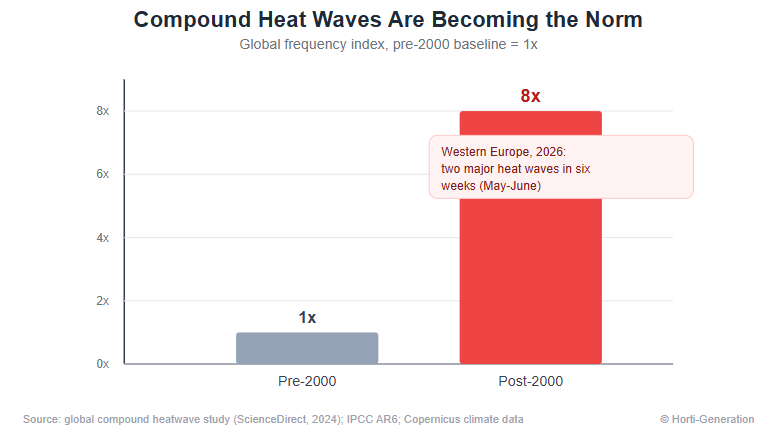
A climate resilient greenhouse is no longer a nice-to-have. Western Europe just went through two brutal heat events in a few weeks. Late May 2026 brought an unusually early heat wave to France, England and Wales. Daily average temperatures ran more than 10°C above normal. Portugal, the UK and Ireland all recorded their highest May temperatures on record. Weeks later, a second wave pushed European cooling demand to its highest level in at least 45 years. France alone reported dozens of heat-related deaths, school closures and rail disruptions.
For context, the Netherlands defines a heat wave as five straight days above 25°C, with at least three of them hitting 30°C. That threshold was built around a mild, humid climate. Today it feels almost quaint. Dutch horticulture has long set the technical benchmark the rest of us build on. So when growers in a temperate country start rethinking their structures, North American growers should pay attention too.
This shift is not a one-off. France entered its 50th recorded heat wave since 1947 back in June 2025. That same summer, Portugal and Spain both broke national records above 46°C. The IPCC has been clear about the trend for years. Every additional 0.5°C of global warming produces a discernible rise in the frequency and intensity of hot extremes, heat waves included. We are not looking at a rare summer anomaly. We are looking at a new baseline, and greenhouse design needs to catch up to it.
What Extreme Heat Does Inside the Growing Zone
Heat stress does not damage every crop the same way. It helps to be specific, because the failure point changes from one species to the next.
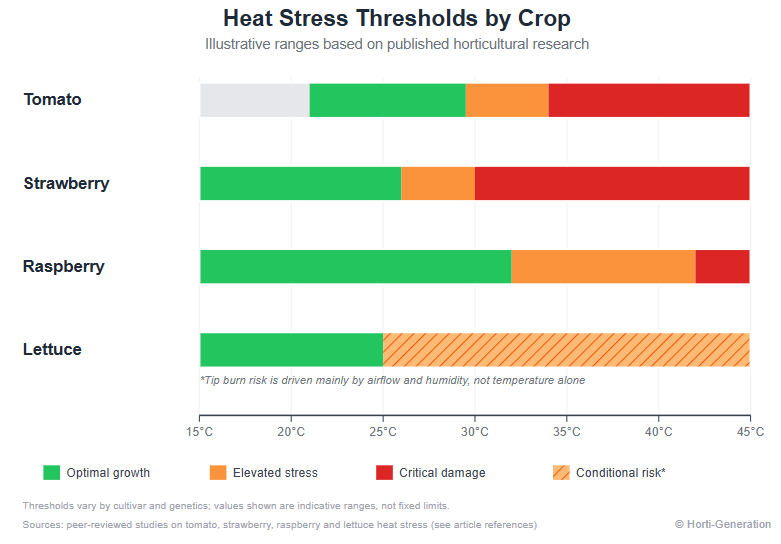
Tomatoes have a well-documented thermal ceiling. Optimal daytime temperatures sit between 21°C and 29.5°C. Critical stress shows up between 34°C and 40°C. Yet you do not need the extreme end to lose yield. Once day and night temperatures pass roughly 32°C and 20°C during the reproductive phase, fruit set and fruit weight both drop. Pollen viability and germination fall off sharply at that point.
Leafy greens fail in a different way. Tip burn, that brown necrosis at the leaf margins, is really a localized calcium deficiency in fast-growing tissue. Calcium moves through the plant with transpiration. So anything that limits airflow or spikes humidity during a heat event chokes off calcium delivery, right when growth is fastest and demand is highest. It is a heat and airflow problem wearing a nutrient disguise. That is why growers who only adjust fertigation often do not see the problem go away.
Strawberries take the hit reproductively. Heat stress reduces flower bud differentiation, pollen viability and fruit set. Studies comparing a 23°C/18°C regime to 30°C/25°C show pollen germination dropping sharply at the higher range. Above roughly 26°C, plants also start to show visible leaf scorching and wilting.
Raspberries and other caneberries show their stress visually. That makes them a useful example. Fruit exposed to temperatures above 42°C can develop white drupelet disorder, essentially sun scald that bleaches the ripening fruit. Even below that point, once summer temperatures push past 32°C, raspberries tend to come in smaller, softer and lower in quality.
Four crops, four different failure points: fruit set, calcium transport, pollen viability and visible fruit damage. Yet they share one root cause. The plant simply cannot regulate its own temperature and water balance once the surrounding air stays too hot for too long.
The Physics Problem: More Light Often Means More Heat
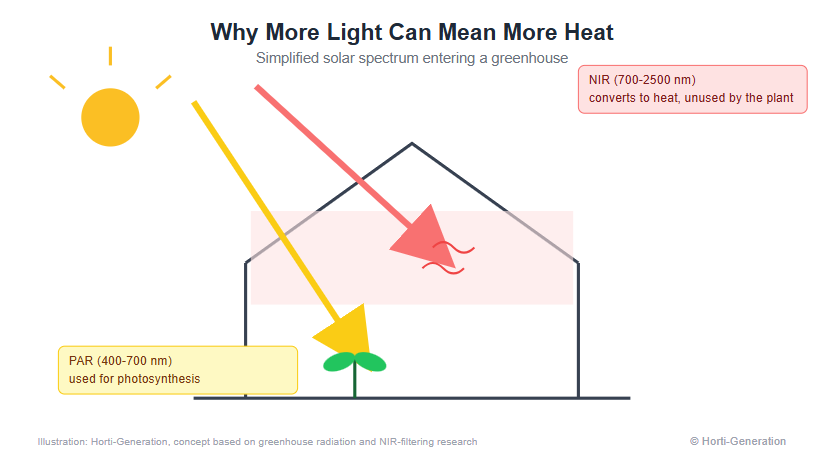
Every greenhouse cover has to navigate one tension. Roughly half of incoming solar radiation falls in the near-infrared band. That part of the spectrum heats the greenhouse without feeding photosynthesis at all. A conventional cover does not tell it apart from the useful light your crop needs. It lets both through more or less equally. That is exactly why a bright, clear day is also the day your greenhouse works hardest against you.
This part of the conversation usually gets skipped. Growers judge light transmission as if more is always better. Once you manage for heat resilience, though, transmission and radiative load become the same coin. A material that is excellent for December can turn into a liability in July.
Where Glass Runs Into Trouble
Glass earns its reputation honestly. It offers excellent light transmission. That makes it a strong fit for temperate climates like the Netherlands, where summers stay mild and humid. It also suits regions buffered by a large thermal mass, such as Leamington in Ontario, where the proximity of Lake Erie moderates temperatures and limits extreme swings. In those settings, glass rarely faces the kind of radiative heat load that turns clarity into a liability.
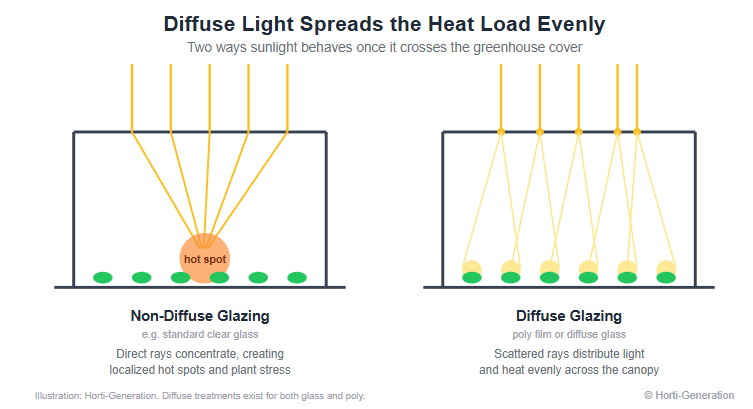
That same clarity becomes the problem once the season flips, at least for standard clear glass. On a clear, high-radiation day, non-diffuse glazing concentrates direct rays into hot spots instead of spreading the energy across the canopy. Diffuse glass does exist, and some modern glass greenhouses now specify it for this reason. Still, it adds cost and complexity to an already premium material. Diffuse poly films reach a similar effect at a fraction of the price. Research on tomato crops in hot, semi-arid regions backs this up, showing diffuse coverings that cut plant stress and lift fruit yield compared to clear glazing during peak summer heat.
Once a glass structure runs hot, the fix gets expensive fast. Even a semi-closed greenhouse with evaporative cooling stays the default for a reason. Full air conditioning or refrigeration for a commercial greenhouse is generally cost-prohibitive to install and run. Fan-and-pad systems carry real ongoing costs too. Their performance also drops off in humid climates, precisely when you need them most. In the US, cooling and ventilation systems on glass structures commonly run two to four dollars per square foot for the equipment alone. That figure comes before water use and maintenance.
None of this makes glass a bad choice. It’s a choice with a climate profile. Glass fits certain regions and certain crops, and it becomes a growing liability wherever heat waves intensify. The pattern already shows on the map. Across most hot southern countries, from Spain and Morocco to Mexico, glass greenhouses stay marginal. Growers there rely overwhelmingly on plastic film structures, which handle high radiation and heat at a far lower cost. Glass concentrates in cooler, higher-latitude markets, and for good reason.
Why Poly Greenhouses Are Better Suited for a Hotter Climate
Here is where structure and geometry start doing real work, quietly, without exotic technology.
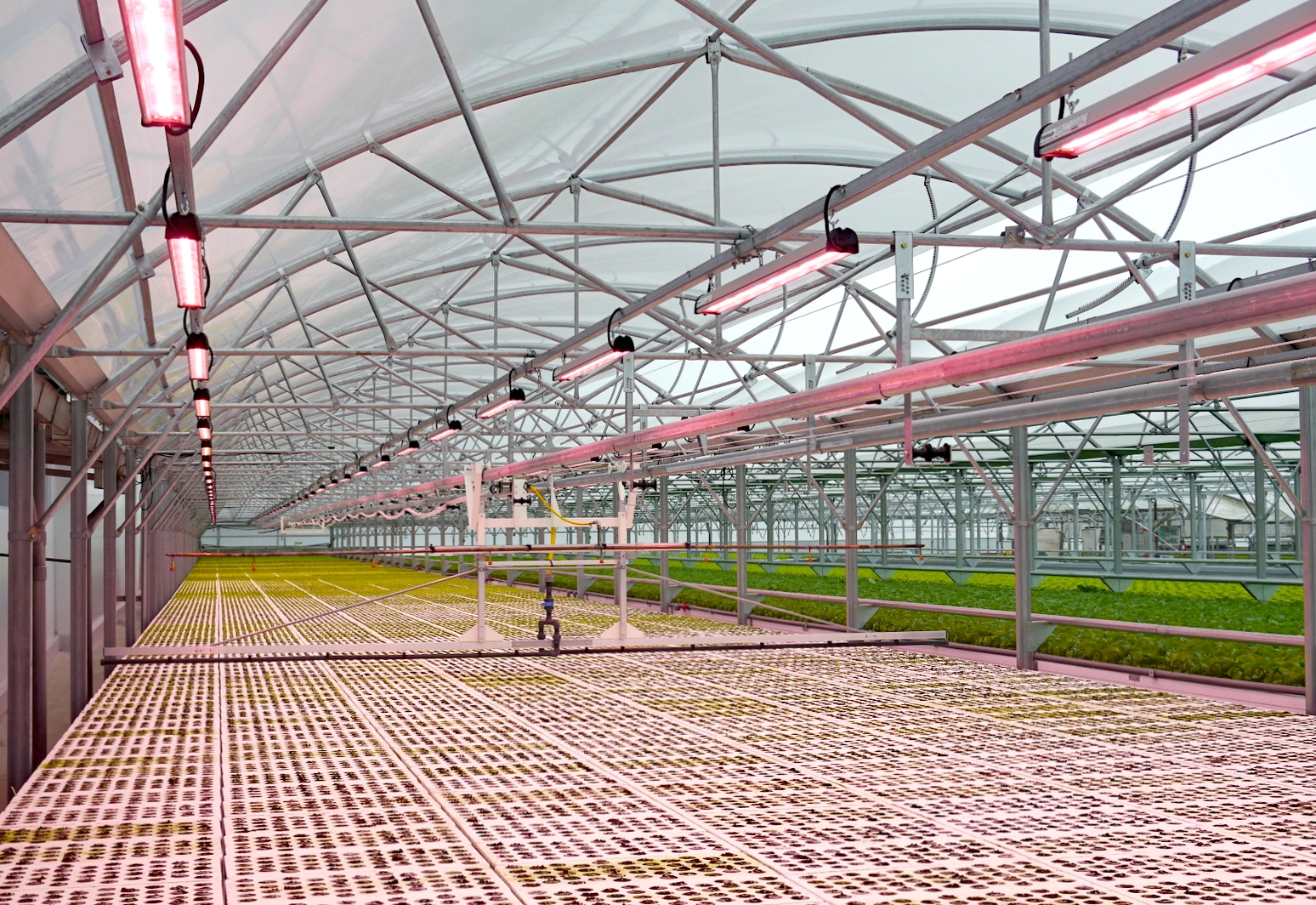
Start with the arch. A Gothic profile structure sheds condensation down the sidewalls instead of dripping onto the canopy below. Flatter quonset or A-frame roofs tend to drip. The steep pitch also does double duty in winter, since it sheds snow and wind load efficiently. So you are not choosing between a summer shape and a winter shape. You get both from one geometry.
Then there is volume. Gutter-connected, multi-span structures carry a larger internal air volume than free-standing greenhouses. That air mass acts as thermal inertia. Outside temperature swings take longer to work their way into a large air volume than a small one. The result is fewer sharp spikes and a more stable internal climate through the hottest part of the day. This is the buffer effect, and it scales directly with height and width.
That detail matters more than it sounds. A recent CFD study compared a high, wide greenhouse against a standard structure under simulated 35°C to 45°C conditions. The taller, wider design improved thermal uniformity and reduced heat stress, especially with hybrid cooling. The mechanism is simple. Taller sidewalls widen the pressure gap between inside and outside air, which strengthens buoyancy-driven natural ventilation. The wider span keeps airflow even across the growing area instead of letting heat and humidity pool near the canopy. In plain terms, a structure built to roughly 6 metres or more under the gutter, with spans of 30 to 42 feet and up, is not just about headroom. It directly flattens the temperature and humidity gradient where your crop grows. That is exactly where heat stress builds first.
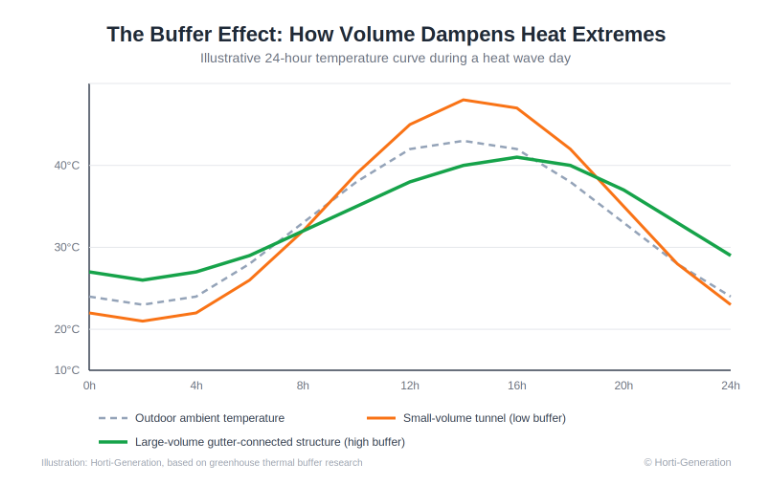
Put the three together. Gothic geometry, a large buffered air volume at real height and width, and a covering film built to manage the heat load at the cover. That last piece deserves a closer look. The real breakthrough is not simply blocking sunlight. Older cooling films and whitewash cut the heat by cutting total light transmission, which also strips out the PAR your crop needs to grow.
Newer NIR-selective cooling films work differently. Using advanced additives, they absorb and dissipate the near-infrared radiation that carries the heat, while still passing the visible light that drives photosynthesis. You lose the heat, not the yield. Documented cooling runs up to about 5°C, with newer composite films reaching 6 to 7°C in trials. That is a real buffer during a heat wave, achieved passively, with no moving parts and no extra energy draw. These films are already proving themselves across hot southern markets like Spain, Morocco and Mexico. Combine the three, and the structure absorbs much of the heat wave problem before any mechanical cooling switches on. That is the difference between a greenhouse that fights the climate and one that works with it.
Low-Tech Gothic Tunnels Have a Role Too
A climate resilient greenhouse is not only a high-capital, gutter-connected conversation. A well-specified tunnel closes a real part of the gap for growers who are not ready for the bigger structure yet. The same buoyancy principle scales down to tunnel geometry. Taller sidewalls, wider roll-up or drop-side openings, and a properly sized ridge vent all move hot, humid air out faster than a low, tightly closed profile. You can also retrofit a next-generation NIR-selective or diffuse film onto an existing tunnel frame without a full rebuild. It is a lower-cost entry point into the same climate logic, not a separate way of thinking.
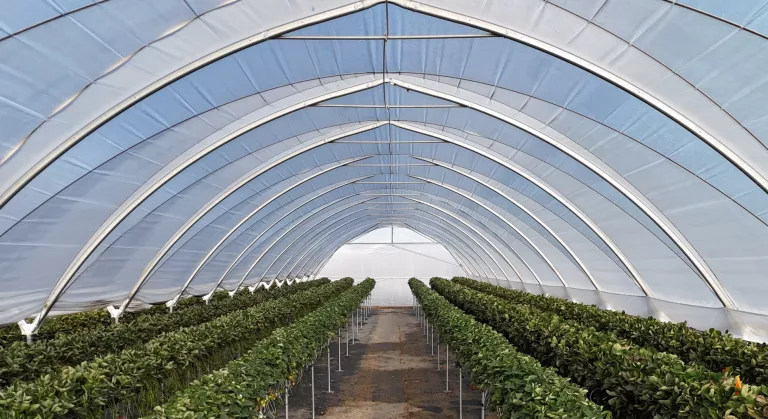
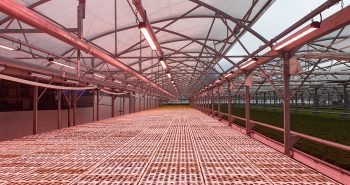
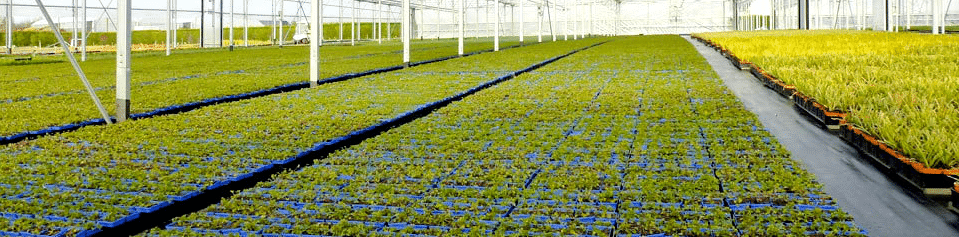
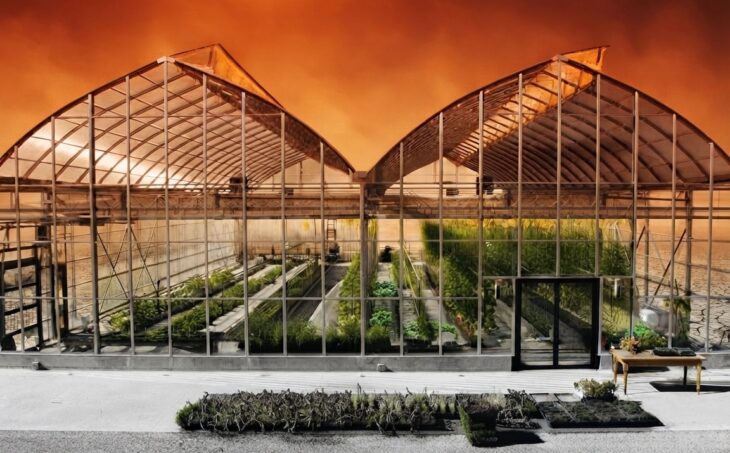
Photos sources from Harnois Greenhouses, North American greenhouse manufacturer.
The Bigger Picture: Agriculture Is Already Adjusting
Zoom out, and this plays out at an industry level too. Controlled Environment Agriculture (CEA) is increasingly framed as a direct tool against the extreme weather that threatens open-field production, including drought, flooding and heat waves.
Market forecasts put CEA growth at roughly 12.42% a year through 2032, and climate volatility drives much of that curve. Growers and investors are reading the same heat wave data we just walked through. They are reaching the same conclusion. Protected structures are no longer a luxury add-on. They are becoming core infrastructure for staying in production at all.
Match the Technology to the Climate Risk
None of this argues for the most expensive or most heavily engineered structure on the market. It argues for matching the structure to the real risk profile of your site and your crop. Most of North America and Western Europe now faces more frequent, more intense heat waves.
So geometry, volume and film choice deserve at least as much attention as heating capacity ever did. A climate resilient greenhouse for 2026 is not always the one that served you well a decade ago. It is the one built for the summers we are actually getting now.
Further reading and sources referenced
- ACS Agricultural Science & Technology, “Near-Infrared Reflective Greenhouse Covering: A Novel Strategy for Electricity-Free Cooling” — https://pubs.acs.org/doi/10.1021/acsagscitech.3c00281
- IPCC AR6 Working Group I, Summary for Policymakers — https://www.ipcc.ch/report/ar6/wg1/chapter/summary-for-policymakers/
- MDPI Agriculture, “CFD-Based Pre-Evaluation of a New Greenhouse Model for Climate Change Adaptation and High-Temperature Response” — https://www.mdpi.com/2077-0472/15/24/2614
- PubMed, “High-temperature stress in strawberry: understanding physiological, biochemical and molecular responses” — https://pubmed.ncbi.nlm.nih.gov/39419853/
- ScienceDirect, “Intensifying spatially compound heatwaves: Global implications to crop production and human population” — https://www.sciencedirect.com/science/article/abs/pii/S0048969724030614
- Springer Nature, “Physiological and growth responses of tomato plants to heat stress” — https://link.springer.com/article/10.1007/s44372-025-00462-3