
This post is also available in:  English
  Français (French)
If you run an independent garden center or nursery in the United States or Canada, you already know the pressure. Your spring selling window is short. Big-box competitors have more floor space and lower prices. Labor is expensive and hard to find. And every year, you are expected to deliver a better customer experience with roughly the same infrastructure you have been running for years.
A well-designed commercial greenhouse will not solve all of those problems. But it will solve several of the most important ones, and it will do it in a way that is visible, lasting, and difficult for your competitors to replicate.
This article looks at what a commercial retail greenhouse actually does for a garden center business, what to evaluate before investing, and what one Quebec operation has demonstrated is possible when the investment is made thoughtfully.
Why Independent Garden Centers Are Investing in Commercial Greenhouses Right Now
The numbers support the decision. Garden center frontline sales in spring 2025 were up 27% from 2020, with strong demand for both edibles and ornamentals. The flowers and ornamentals segment of the North American commercial greenhouse market is projected to grow at a CAGR of 14.2% through the forecast period, driven by experiential retail trends and growing consumer interest in plants for home and wellness.
Gardening has proven recession-resistant. In 2008, 2020, and again in 2025, consumer spending on plants and garden products held up when other retail categories softened. Independent garden centers that invested in their facilities during these periods came out stronger. Those that waited found themselves competing on price alone, a battle they rarely win against larger operators.
The window for differentiation is open. The question is what kind of infrastructure will actually move the needle for your specific operation.
What a Commercial Greenhouse Can Do for Your Garden Center: Lessons from a Quebec Operation
Category: Building | Posts Read time: 10 min Focus keyphrase: commercial greenhouse garden center
If you run an independent garden center or nursery in the United States or Canada, you already know the pressure. Your spring selling window is short. Big-box competitors have more floor space and lower prices. Labor is expensive and hard to find. And every year, you are expected to deliver a better customer experience with roughly the same infrastructure you have been running for years.
A well-designed commercial greenhouse will not solve all of those problems. But it will solve several of the most important ones, and it will do it in a way that is visible, lasting, and difficult for your competitors to replicate.
This article looks at what a commercial retail greenhouse actually does for a garden center business, what to evaluate before investing, and what one Quebec operation has demonstrated is possible when the investment is made thoughtfully.
Why Independent Garden Centers Are Investing in Commercial Greenhouses Right Now
The numbers support the decision. Garden center frontline sales in spring 2025 were up 27% from 2020, with strong demand for both edibles and ornamentals. The flowers and ornamentals segment of the North American commercial greenhouse market is projected to grow at a CAGR of 14.2% through the forecast period, driven by experiential retail trends and growing consumer interest in plants for home and wellness.
Gardening has proven recession-resistant. In 2008, 2020, and again in 2025, consumer spending on plants and garden products held up when other retail categories softened. Independent garden centers that invested in their facilities during these periods came out stronger. Those that waited found themselves competing on price alone, a battle they rarely win against larger operators.
The window for differentiation is open. The question is what kind of infrastructure will actually move the needle for your specific operation.
What a Commercial Retail Greenhouse Does That a Standard Growing Structure Does Not
Most commercial greenhouses are designed around the needs of the plants. A retail greenhouse for a garden center must also be designed around the needs of the customer and around the needs of your business model.
Here is what that looks like in practice:
It Extends Your Revenue Season
A well-engineered retail greenhouse lets you open earlier in spring and stay open later in fall. In most regions of the US Northeast and Canada, that means recovering 4 to 8 weeks of selling time that an open-air operation simply cannot access.
Beyond spring and fall extension, a year-round retail greenhouse opens entirely new revenue categories: Christmas trees and seasonal décor in November and December, tropical houseplants and indoor foliage year-round, and early-season vegetable starts and herbs from February onward. These are product lines that consumers are actively seeking and that your operation currently cannot serve if you close for the winter.
It Improves Plant Quality and Reduces Shrinkage
Plants held in a well-managed retail greenhouse experience less stress than plants left on outdoor benches exposed to late frosts, heavy rain, and temperature swings. Less stress means better appearance, slower deterioration, and fewer markdowns. For any garden center that has written off significant inventory losses in a difficult spring, this is a direct and measurable return on investment.
It Becomes Your Most Powerful Marketing Asset
An architecturally distinctive greenhouse is visible from the road. It communicates quality, expertise, and permanence before a customer has even pulled into your parking lot. In a market where independent garden centers are competing against the garden sections of Home Depot and Lowe’s, that visual differentiation matters more than most operators realize.
Customers photograph greenhouse retail environments and share them on social media. They recommend them to friends. They come back not just to buy plants but to experience the space. A well-designed commercial greenhouse turns a transaction into a destination, and destination retail is the most durable competitive advantage an independent operator can build.
It Reduces Labor Dependency at Peak Moments
Automated climate control and irrigation reduce the number of staff hours required to maintain plant health during your busiest weeks. When you are running flat out during the spring rush and every person on your team is needed for customer service and sales, not watering and monitoring, the operational efficiency of a well-equipped greenhouse pays for itself in ways that are hard to quantify but immediately felt.
What Pépinière Abbotsford Built and Why It Works
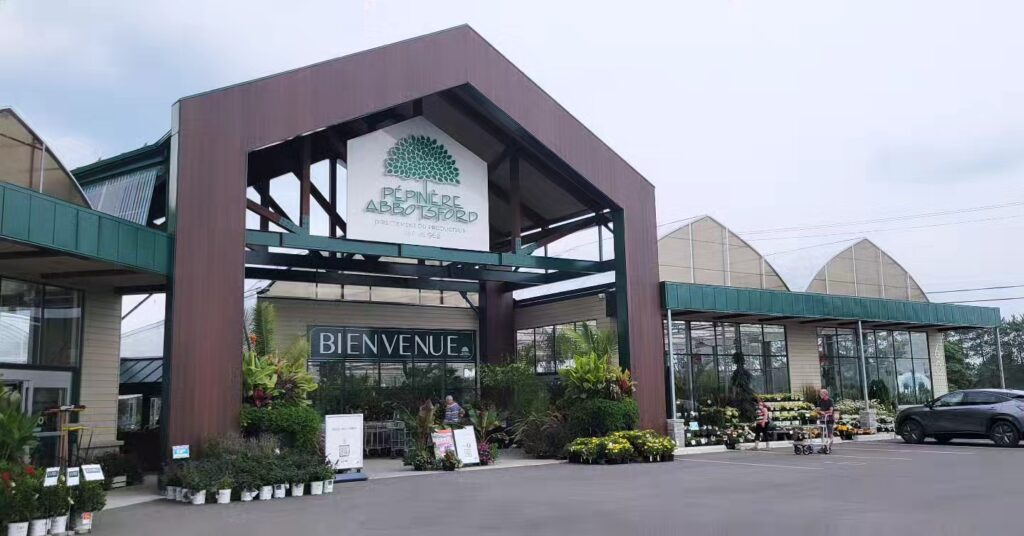
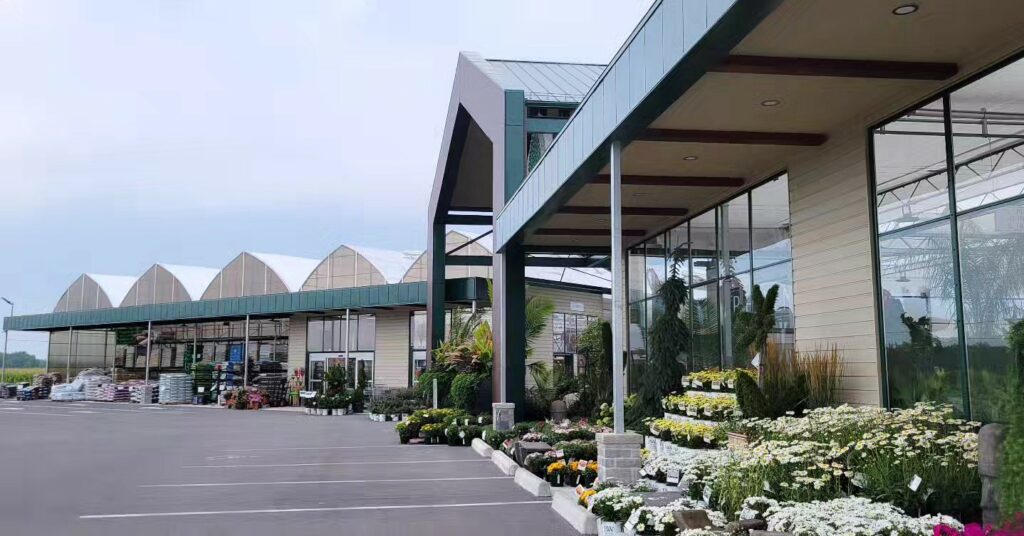
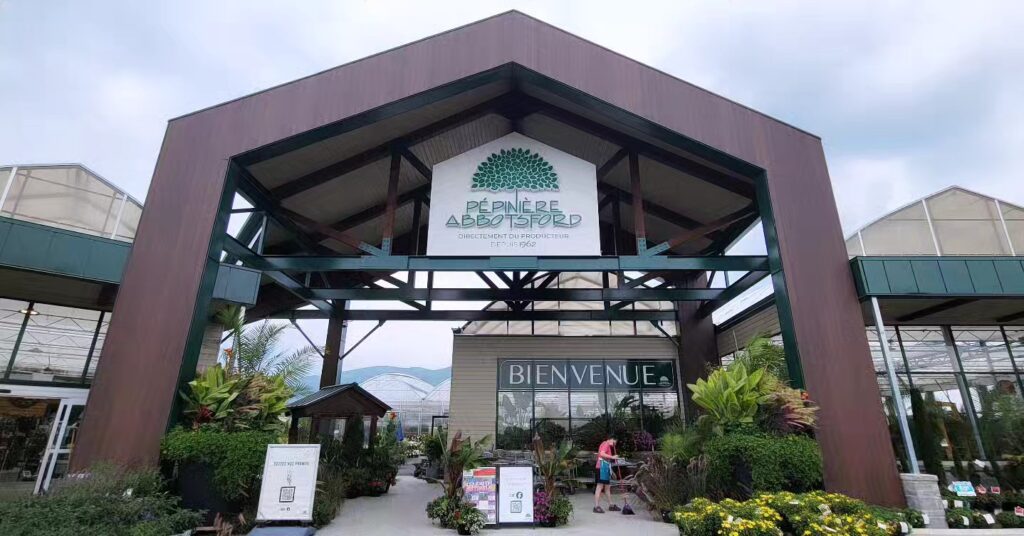
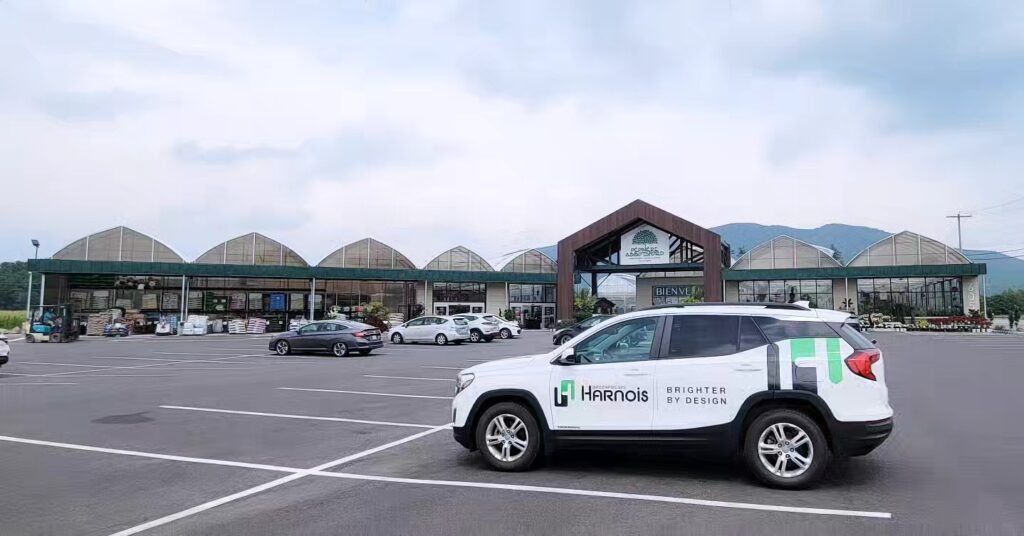
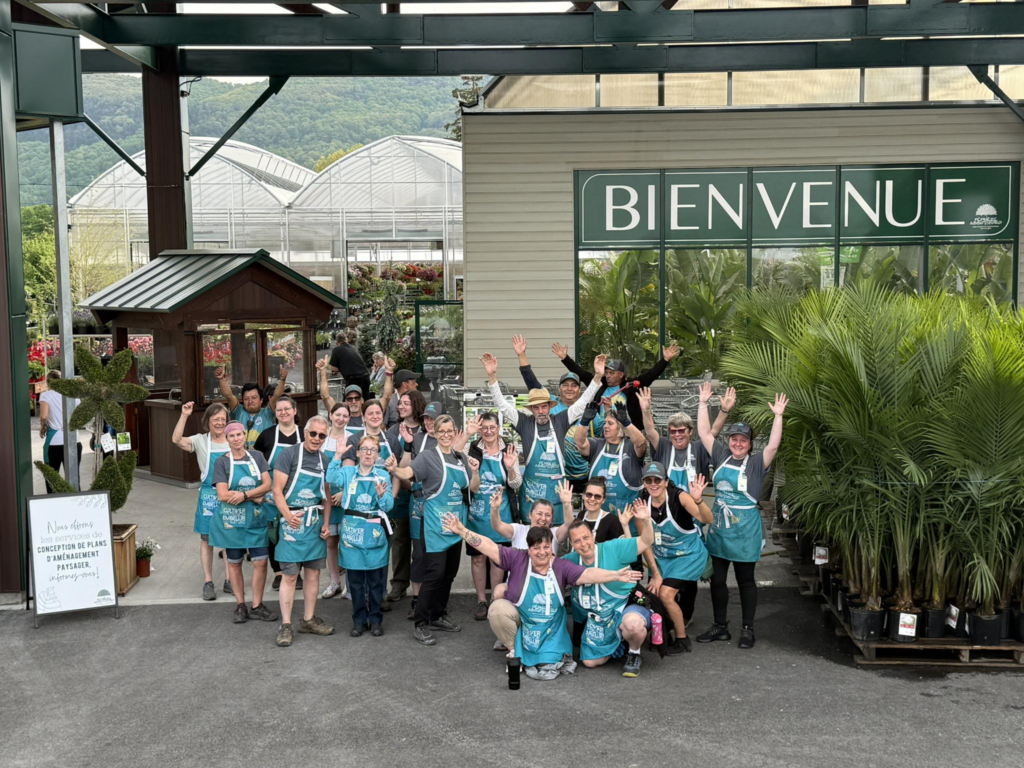
Pépinière Abbotsford is a garden center in Quebec’s Montérégie region, recognized as one of the most distinctive horticultural retail operations in North America. Their competitive advantage is built primarily around their greenhouse.
The structure combines glass facades at customer level, maximizing light transmission and visual impact, with a double-layer inflated polyethylene roof system that provides thermal efficiency during the critical early spring shoulder season when heating costs matter most. Climate control and irrigation are fully automated. The architectural result is a space that is immediately striking from the exterior and genuinely enjoyable to shop in from the interior.
This is not a utilitarian growing structure positioned behind a separate retail building. The greenhouse is the retail building. It is the first thing customers see when they arrive, the space they spend the most time in, and the reason they tell friends to visit.
Several structural decisions made this possible:
High light transmission. The covering system was specified to maximize natural light throughout the interior. Plants look their best in bright, even light, and so do customers. A retail greenhouse that is dim or uneven in its lighting misses one of the most important opportunities the structure provides.
Generous interior volume. High interior clearance gives the space an open, airy feeling that encourages browsing rather than rushing. It also allows for taller specimen plants and seasonal displays that would be impossible in a lower-clearance structure.
Climate zoning. Different areas of the greenhouse maintain different temperature and humidity ranges, allowing the operation to display tropical plants, hardy perennials, and seasonal annuals simultaneously without compromising any of them.
Modular expansion design. The structure was designed from the start with future expansion bays in mind. Adding capacity does not require rebuilding; it requires adding modules to an existing engineered framework.
Common Mistakes Garden Centers Make When Planning a Greenhouse Investment
After working with garden centers and nurseries across Canada and the United States, these are the planning errors that show up most often:
Treating the greenhouse as a growing space rather than a retail space. Production greenhouses and retail greenhouses have different design priorities. If your structure is optimized for plant production but not for customer comfort, traffic flow, and merchandising, you will underperform on the revenue side regardless of what it does for your plants.
Undersizing for your market. A greenhouse that fills up on your first busy spring weekend is a greenhouse that is already too small. Plan for your growth trajectory, not your current volume. Modular structures allow phased expansion, but the initial footprint and engineering need to account for where you want to be in five years.
Choosing the lowest bid without checking engineering credentials. Commercial retail greenhouses in both Canada and the US are subject to local building codes. In Canada, this means compliance with the National Building Code (NBC) and provincial requirements. In the US, the International Building Code (IBC) and state-level equivalents apply. A structure that arrives without engineer-stamped drawings for your specific climate zone creates insurance, liability, and funding eligibility problems that a lower purchase price will not offset. Always ask for documented engineering credentials before signing.
Ignoring the shoulder season economics. The ROI calculation for a retail greenhouse is often based on spring revenue. But the shoulder seasons (late February through April and September through November) are where the real return accumulates. A structure that is properly specified for thermal performance in your climate will pay back its cost significantly faster than one that is only usable from May through August.
Skipping the customer experience planning. Aisle width, sight lines, plant display height, checkout flow, and the quality of natural light at different times of day all affect how long customers stay in your greenhouse and how much they spend. These decisions need to be made during the design phase, not after the structure is built.
What to Evaluate Before You Invest
If you are a garden center or nursery owner in the US or Canada considering a commercial greenhouse investment, here are the questions that will shape your decision:
What is your primary selling season, and how would a greenhouse extend it? Map out the weeks of the year when you are currently losing revenue because you cannot protect your inventory or provide a covered shopping environment. That lost revenue is your baseline ROI case.
Who is your target customer, and what kind of experience do they expect? A greenhouse designed for professional landscapers picking up bulk orders looks different from one designed for weekend consumer shoppers. Your structure should match your customer base.
What does your site allow? Footprint, orientation, access, and local zoning all constrain your options. A site visit and engineering assessment before you finalize a design will save significant time and cost.
What is your five-year growth plan? A modular structure that grows with you is almost always a better investment than a fixed structure you will outgrow.
What financing and incentive programs are available to you? In Canada, federal and provincial programs including AgriInvest, MAPAQ grants in Quebec, and Canadian Agricultural Partnership funding have historically supported protected agriculture infrastructure investments. In the US, USDA programs including the Environmental Quality Incentives Program (EQIP) and various state-level agricultural development funds provide support for eligible greenhouse projects. A qualified agronomist or greenhouse consultant can help you identify what applies to your situation.
The Business Case in Plain Terms
A retail greenhouse for your garden center is not a cost. It is a revenue infrastructure investment with a quantifiable return.
The return comes from four sources that compound over time: additional weeks of selling season, higher average transaction value driven by a better in-store experience, reduced inventory loss from weather and temperature stress, and a stronger brand position that drives customer loyalty and word-of-mouth.
For most well-planned garden center greenhouse projects in North America, payback occurs within 3 to 5 years depending on scale, market, and management quality. Operations that leverage the structure for year-round retail, not just spring annuals, consistently achieve faster returns.
Pépinière Abbotsford in Quebec is one example of what the upside looks like when the investment is made well. It is not the only one. Across Canada and the United States, independent garden centers that have committed to their retail greenhouse infrastructure are consistently outperforming those that have not, not because of luck, but because of the structural advantages the investment provides.
Getting Started
If you are evaluating a commercial greenhouse for your garden center, the first step is clarifying your business model and growth goals before you talk to any supplier. Know what selling season extension is worth to your operation. Know what customer experience you are trying to create. Know your site constraints and your five-year trajectory.
With that clarity, you can evaluate structures and suppliers against your actual needs rather than against generic specifications, and you will make a significantly better decision as a result.
Written by Corenthin (Félix) Chassouant, Agronomist (MSc, Agr.) and VP of Sales and Business Development at Industries Harnois. 10+ years advising commercial greenhouse operations and garden centers across North America.
Learn more about my background
Related articles: