
This post is also available in:  English
  Français (French)
High tunnel berry production in North America has grown steadily over the past decade, and for good reason. Strawberry and raspberry growers across Canada and the United States are under real pressure: shorter growing windows, unpredictable weather, and stiff competition from imported berries produced at lower cost in California, Mexico, and beyond.
High tunnels offer a practical, cost-effective way to push back. They extend your season, protect your crop, and improve fruit quality without the full capital and energy costs of a heated greenhouse. But choosing the right system, understanding the agronomic differences between crops, and sizing your investment correctly are what separate a profitable operation from an expensive lesson.
This guide covers what North American berry growers need to know before investing in high tunnel production.
Why High Tunnel Berry Production Makes Sense in North America
Open-field strawberry and raspberry production in Canada and the northern United States is constrained by a narrow growing window. Spring frosts arrive late, fall frosts arrive early, and summer rain events can devastate fruit quality in a matter of hours. High tunnels address all three.
A well-designed high tunnel creates a protected microclimate that delivers measurable benefits:
Season extension. In most regions of Quebec, Ontario, and the US Northeast, high tunnels can push your first harvest 2 to 4 weeks earlier in spring and extend production 3 to 5 weeks further into the fall compared to open-field growing. For fall-bearing raspberry varieties, that extension can mean the difference between a profitable fall harvest and a frost-cut season.
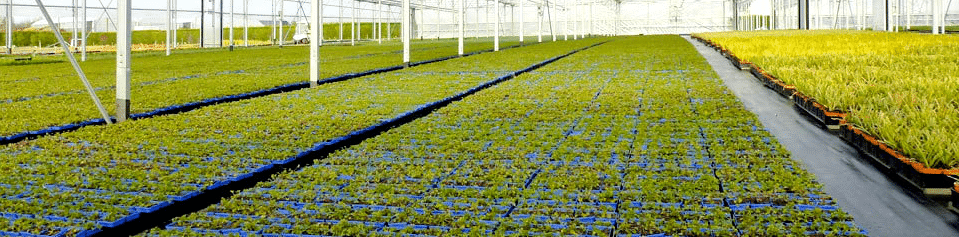
Yield improvement. University trials across several US states have consistently shown that berry crops grown in high tunnels outperform field production by 30% or more in yield, depending on variety selection, crop management, and local conditions. For strawberries grown on elevated gutters in tunnels, yields of 15 kg/m² or more are achievable in optimized systems.
Fruit quality protection. Rain exclusion is one of the most significant advantages of tunnel production. Botrytis gray mold is the number one quality threat for raspberries and strawberries in humid climates. Keeping rain off the fruit dramatically reduces disease pressure and extends shelf life, a meaningful advantage when selling to regional distributors or grocery chains that demand consistent quality.
Labor efficiency. Elevated gutter systems for strawberries bring the crop to working height. Combined with a drier, cleaner environment, tunnels make harvest faster and easier, which matters when labor is both scarce and expensive.
Strawberries vs. Raspberries in High Tunnels: Key Differences
Not all berry crops respond the same way to tunnel production. Understanding the agronomic differences between strawberries and raspberries will help you match the right system to your operation.
Strawberries
Strawberries in high tunnels are most commonly grown on elevated gutters filled with coconut coir or peat, with drip irrigation and fertigation. The two main production strategies in North American tunnels are:
June-bearing varieties produce a single concentrated flush in late spring. In a tunnel, this window starts earlier and yields higher-quality fruit, but the production period remains short. This strategy works well for operations with direct-market channels where premium pricing justifies the infrastructure.
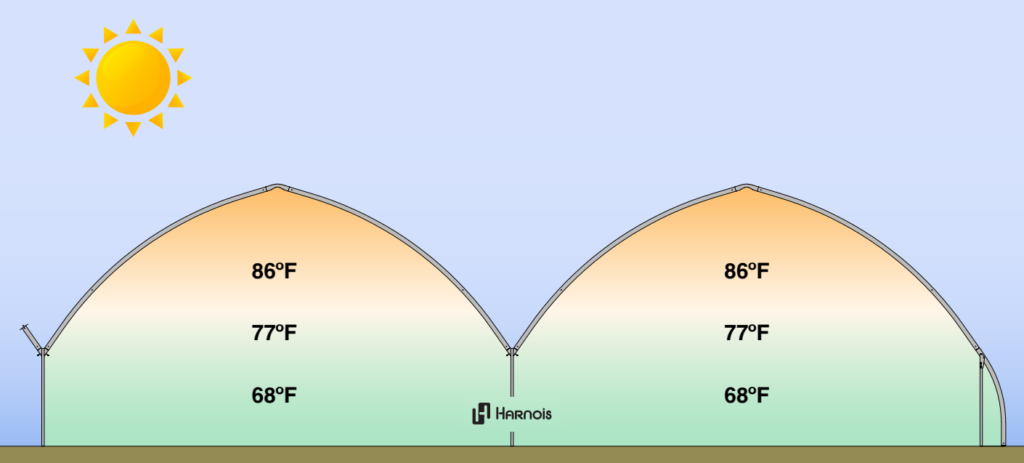
Day-neutral varieties (such as Albion, Seascape, or newer Canadian-bred selections) can produce fruit continuously from spring through fall when temperatures are managed well. Heat is the primary challenge: above 26°C, flower production slows significantly. Ventilation management (roll-up sides, end-wall vents, and strategic shading in peak summer) is critical for day-neutral production to perform through July and August.
The combination of elevated gutters and day-neutral varieties is increasingly popular among commercial growers in Quebec and Ontario. It allows year-round optimization of the growing environment and significantly improves labor efficiency at harvest.
Raspberries
Raspberries behave differently depending on the variety type:
Primocane-fruiting (fall-bearing) varieties are the most practical fit for high tunnel production in Canada and the northern US. These varieties produce on first-year canes in late summer and fall. In a tunnel, the harvest season starts earlier and extends further into the season. Plastic can be removed in winter once canes are cut back, which means the structure does not need to carry full snow loads and can be built lighter.
Floricane-fruiting (summer-bearing) varieties require overwintering canes in good condition, which means the tunnel structure must remain standing year-round and be engineered for snow loads in your region. In return, these varieties can deliver a summer crop 2 to 3 weeks earlier than field production: a strong advantage for accessing early-season markets.
For most new entrants to high tunnel berry production in Canada, primocane raspberries and day-neutral strawberries represent the lowest-risk starting point.
Blueberries
High tunnel blueberry production is a growing niche in the Pacific Northwest and parts of Eastern Canada. The primary advantage is rain exclusion during harvest, which dramatically reduces fruit cracking and botrytis pressure. Blueberries require a more permanent substrate and container system than strawberries or raspberries, and the investment is higher. But for growers with established blueberry operations facing quality losses from summer rain, tunnel production is worth a serious look.
High Tunnel Berry Production in Canada: What Quebec and Ontario Growers Need to Know
Canadian growers face specific structural and climate considerations that American extension publications rarely address. This section is written specifically for producers operating in Quebec, Ontario, and other colder regions of Canada.
Three-Season vs. Year-Round: Understanding What You Are Buying
This is one of the most important distinctions for Canadian berry growers to understand before investing. Three-season high tunnels are not engineered structures. They are designed to be used from spring through fall, with the polyethylene film removed or rolled up at the ridge before winter. They are not rated for snow loads, are not engineer-stamped, and should never be left standing with plastic on in regions where significant snow accumulation occurs.
This is not a limitation; it is simply what the product is designed to do. For primocane raspberry production, where canes are cut back in the fall, and the tunnel is not needed in winter, a three-season tunnel is a perfectly appropriate and cost-effective solution. The plastic comes off in late October, the structure weathers the winter as a bare frame, and production resumes the following spring.
The situation changes if your production model requires year-round plastic coverage, for example to overwinter floricane raspberry canes or to run a very early spring strawberry program. In that case, you need a fully engineered greenhouse structure rated for your regional snow loads, with engineer-stamped drawings and compliance with the National Building Code of Canada (NBC). This is a fundamentally different product and a significantly higher investment. Be clear on which category your project falls into before you request quotes.
Producer Examples in Quebec
Several Quebec operations have demonstrated the viability of high tunnel berry production at commercial scale. Producers like Ferme Gadbois (strawberries, Luminosa greenhouse system) and Production Lareault (strawberry propagation) have invested in protected production and achieved results that are reshaping expectations for what is possible in a Quebec growing season. These are not small-scale experiments. They are commercial operations producing at scale for regional markets.
What to Look for When Choosing a Commercial High Tunnel
Not all high tunnel systems are equal, and the lowest purchase price is rarely the best measure of value. Here is what to evaluate before signing a purchase order:
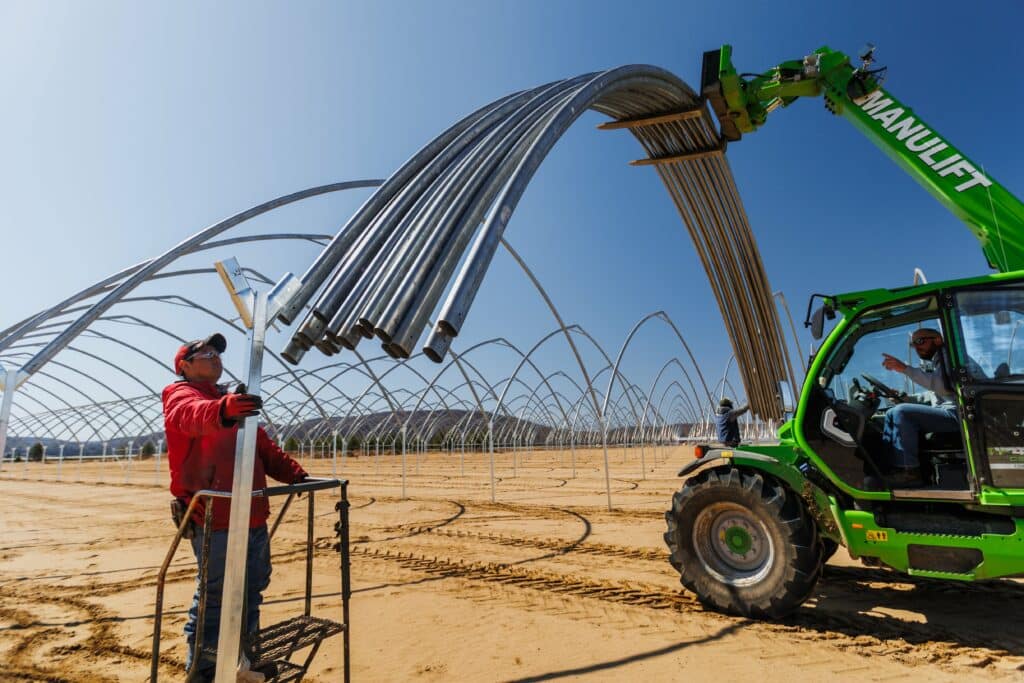
Frame strength and engineering. Look for heavy-gauge galvanized steel with oval-section arches, which offer greater resistance to wind and snow loads than round-section tubing. Ask for load ratings, not just specifications. If your supplier cannot provide engineer-stamped drawings for your region, look elsewhere.
Clearance height. A minimum interior height of 16 to 18 feet (approximately 5 to 5.5 meters) gives you room for elevated gutter systems, irrigation infrastructure, and equipment access. Taller is generally better for ventilation and working conditions.
Span width. Wider spans (30 feet and above) allow multiple production rows under a single cover and reduce the cost per square foot of protected space. Make sure the span matches your row configuration and equipment width.
Ventilation options. Roll-up sides are the minimum requirement for summer berry production. End-wall vents and ridge ventilation significantly improve temperature management in hot weather. Insufficient ventilation is one of the most common mistakes in high tunnel design, particularly for day-neutral strawberry production.
Anchoring system. Screw-pile anchors allow installation without concrete and can be removed or relocated if needed. This is a meaningful advantage on leased land or for operations that may need to adapt their layout over time. Verify that the anchoring system is rated for your soil type and wind exposure.
Choose Made in North America. Structures manufactured in Canada or the US are engineer-stamped for your snow zone, built to meet the NBC or IBC, and comply with recognized steel and galvanization standards (ASTM A123, CSA G164). That certification matters for insurance and funding eligibility. Overseas structures often arrive with thinner galvanization, inconsistent steel grades, and no load ratings for your region, a lower sticker price that can cost far more over time. Before you sign, ask your supplier for documented steel specs and galvanization certificates. A reputable North American manufacturer will provide them without hesitation.
ROI Analysis: High Tunnel vs. Open Field Berry Production
The economics of high tunnel berry production vary widely by scale, crop, market channel, and management quality. Here are realistic benchmarks based on North American commercial operations:
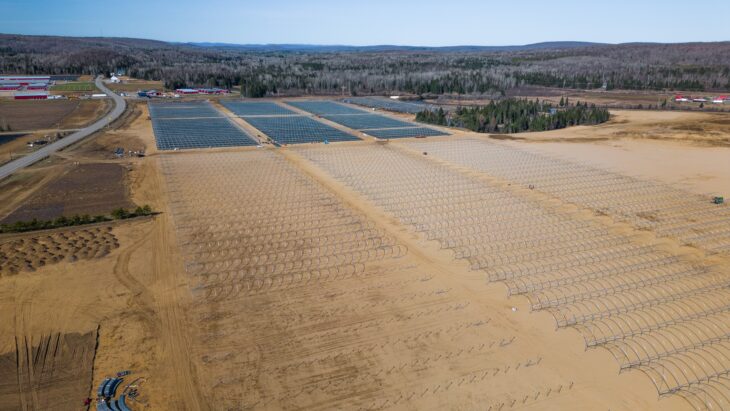
Capital cost. A commercial-grade high tunnel system in North America typically costs between $1.50 and $3.00 per square foot of covered growing space, depending on structure specifications, site preparation, and ancillary equipment (irrigation, gutters, climate monitoring). At the lower end, a simple single-bay tunnel on ground level; at the higher end, a multi-bay system with elevated gutters and full fertigation.
Revenue potential. For optimized strawberry production on elevated gutters with day-neutral varieties, yields of $80,000 to $120,000 per acre are achievable in well-managed operations at commercial scale. Raspberry operations in high tunnels targeting premium direct-market or regional wholesale channels typically generate strong returns per square foot given the high per-pound price of raspberries relative to strawberries.
ROI timeline. For most well-managed high tunnel berry operations in Canada and the US, payback on the infrastructure investment occurs within 2 to 4 years. Operations that sell direct (farmers markets, CSA, farm stands) typically recover costs faster due to higher margins. Operations selling wholesale face more pressure and need to focus on volume and consistency.
Comparison with open-field. Open-field strawberry and raspberry production in the northern US and Canada has lower upfront costs but significantly higher variability in yield and quality. A single late-spring frost or a wet harvest season can eliminate a large portion of the crop’s value. High tunnels reduce that variability, and for lenders, investors, and buyers, predictability has real financial value.
Conclusion: High Tunnel Berry Production as a Long-Term Strategy
For North American berry growers evaluating protected production, high tunnels remain the most accessible entry point, combining meaningful agronomic benefits with a realistic return on investment. The key is matching the right structure to your climate, your crop, and your market.
The growers who succeed in high-tunnel berry production are not necessarily those with the most advanced technology. They are the ones who did their homework, matched their infrastructure to their market, and managed their operation with precision from day one.
Written by Corenthin (Félix) Chassouant, Agronomist (MSc, Agr.) and VP of Sales and Business Development at Industries Harnois. 10+ years advising commercial greenhouse producers across North America.
Learn more about my background
Complementary sources: