
This post is also available in:  English
  Français (French)
High Tunnel Water Management for Drought-Prone Farms
Across western North America, water is running out faster than farms can adapt. The American West is in its driest 22-year stretch in at least 1,200 years, from Arizona and New Mexico to California, and roughly 42 percent of that megadrought traces to human-caused climate change (Williams et al., 2022). The same heat and dryness feed fire. Forecasters expected the 2026 season to burn more than 5.5 million acres across the western United States, after a spring that left California’s snowpack near a fifth of normal (AccuWeather, 2026). Drought, heat, and fire have become one connected problem, and agriculture sits in the middle.
California feels it sharpest. The coastal counties that grow most of the continent’s strawberries run largely on groundwater, which provides about 40 percent of the state’s water in a normal year and up to 60 percent during drought (California DWR). Under the Sustainable Groundwater Management Act, those basins must return to balance by the early 2040s, which means real cuts to farm pumping (PPIC, 2025). Strawberries are salt-sensitive, and a falling water table concentrates salt in the root zone (UC ANR). The pressure is not only western either. Water quality and supply are tightening across growing regions, from the Prairies to the Northeast, so for a grower almost anywhere, drought has stopped being a bad-year risk to absorb. It is a structural threat, closer to a design problem than a weather problem.
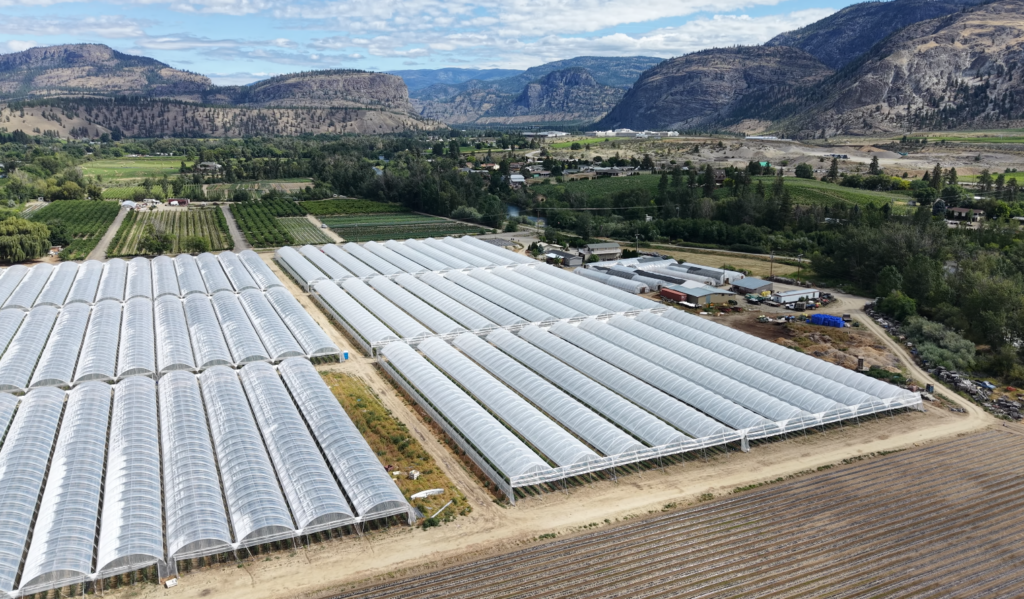
Protected cultivation is one of the few levers a grower controls directly, and governments now treat it that way. British Columbia, after back-to-back drought years that helped push provincial farm losses to the largest in Canada in 2024 (Statistics Canada), put 80 million dollars into helping farms capture, store, and manage water and upgrade irrigation (Government of B.C.). A field-scale tunnel, built around the right irrigation and water storage, turns an unreliable supply into a managed one. It works the same way for berries and for market-garden vegetables.
Every drop counts, so drip is the baseline
When water is scarce, application efficiency is the first place to win. Field efficiency runs about 90 percent for drip, against roughly 75 percent for sprinkler and 60 percent for surface irrigation (FAO). Growers who move from furrow or sprinkler to drip typically cut water use by 30 to 60 percent (FAO). Under a tunnel, moisture can be steered precisely, and that precision shows up directly in fruit quality.
The system has to be built to the site, though: emitter spacing matched to soil texture, fertilizer injection with pH control, filtration, and the salinity control that matters more each year as groundwater draws down. Where the source water is already degraded, that can mean reverse osmosis or blending to hold salts in range. This is the quiet, decisive work of irrigation specialists such as Dubois Agrinovation.
What a tunnel and soilless growing actually save
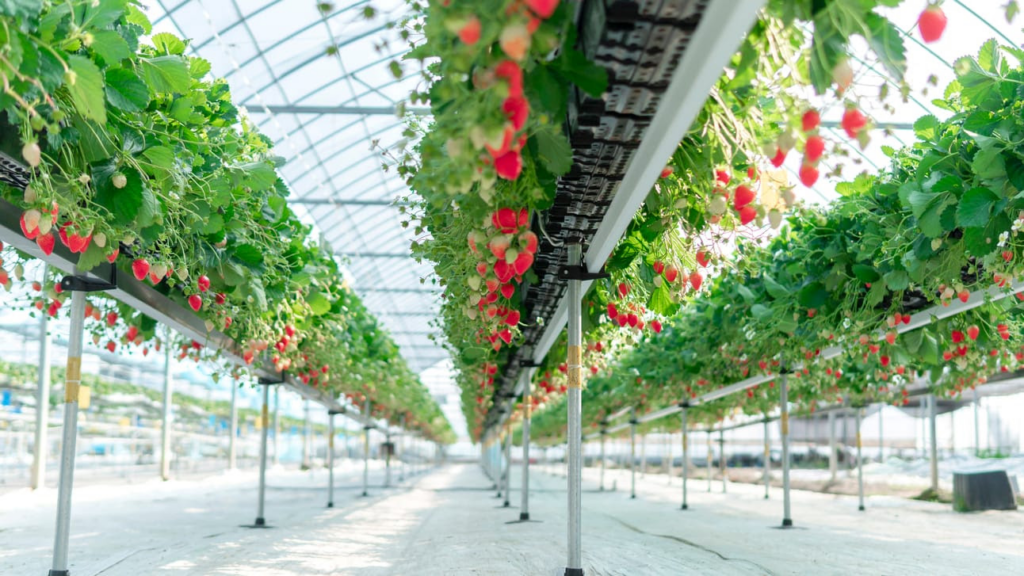
In a large soft fruit tunnel the crop usually grows soilless on substrate, most often coconut coir, drip-fed, and drained to waste. The water savings come from three separate levers, and it helps to keep them apart.
The structure itself lowers evapotranspiration and crop water demand. High-tunnel tomatoes and peppers used about 15 percent less water than the open field (Rho et al., 2020), and protected structures gain more water productivity under deficit irrigation than open ground does (Nazari et al., 2021).
Substrate and precision tighten it further. About 72 litres of water produce a kilogram of fresh strawberries in a soilless system (Cardoso et al., 2021). Sensor-based fertigation raised water use efficiency by 46 percent over simple timer control (Bonelli et al., 2024), and a mild, controlled deficit can trim water by roughly 17 percent with no penalty to marketable yield (AgriEngineering, 2025).
Recirculation is the largest structural saving. Recycling drainage can save up to about 25 percent of water and 35 percent of fertilizer (Lieten), and closed systems run 20 to 30 percent more water- and fertilizer-efficient than open ones (Nam et al., 2024), while also helping manage salt as the source water declines. It is more demanding under a field tunnel than in a glasshouse, since it needs drainage collection, disinfection, and treatment, so it earns its place on some sites and not others.
One figure to leave out of the conversation is the familiar “up to 90 percent water savings.” That belongs to recirculating hydroponic leafy greens such as NFT lettuce (Barbosa et al., 2015), not strawberries on substrate under a tunnel. The real savings here are strong enough without borrowing a number from a different crop and a different system.
The cheapest water is the rain you already have
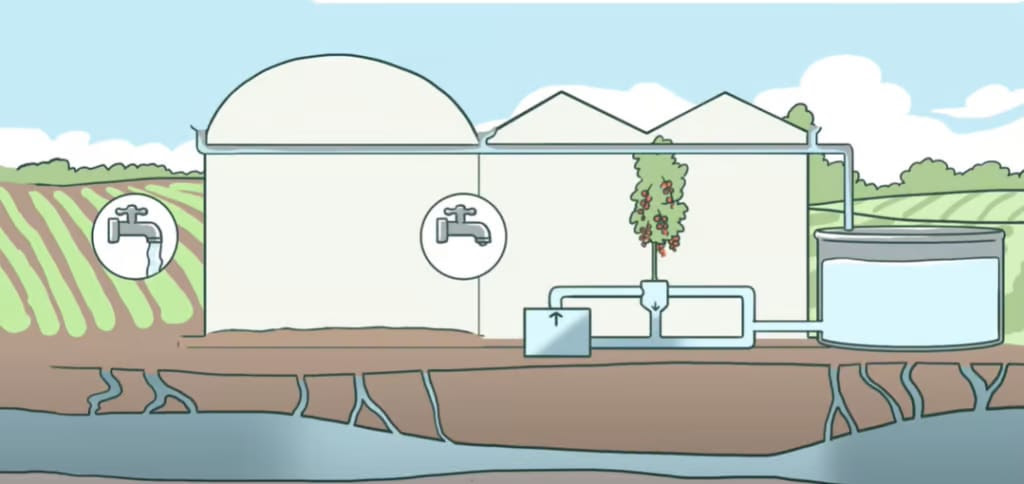
In a drought-prone region, the cheapest water is the rain you already have, and as California shows, most of it currently runs off tunnel roofs unused. A roof collects roughly one litre per square metre for every millimetre of rainfall, so a hectare of roof under 800 mm of annual rain can intercept on the order of 8 million litres before losses. Harvested rainwater is naturally low in salt, which suits a soilless crop and is a real advantage where groundwater is turning brackish. It also cuts dependence on wells or municipal supply exactly when both are stressed. A tunnel with integrated rainwater gutters turns the roof into a collection surface by design, the same capture-and-store logic British Columbia is now funding at the provincial level.
Matching the structure to the water reality
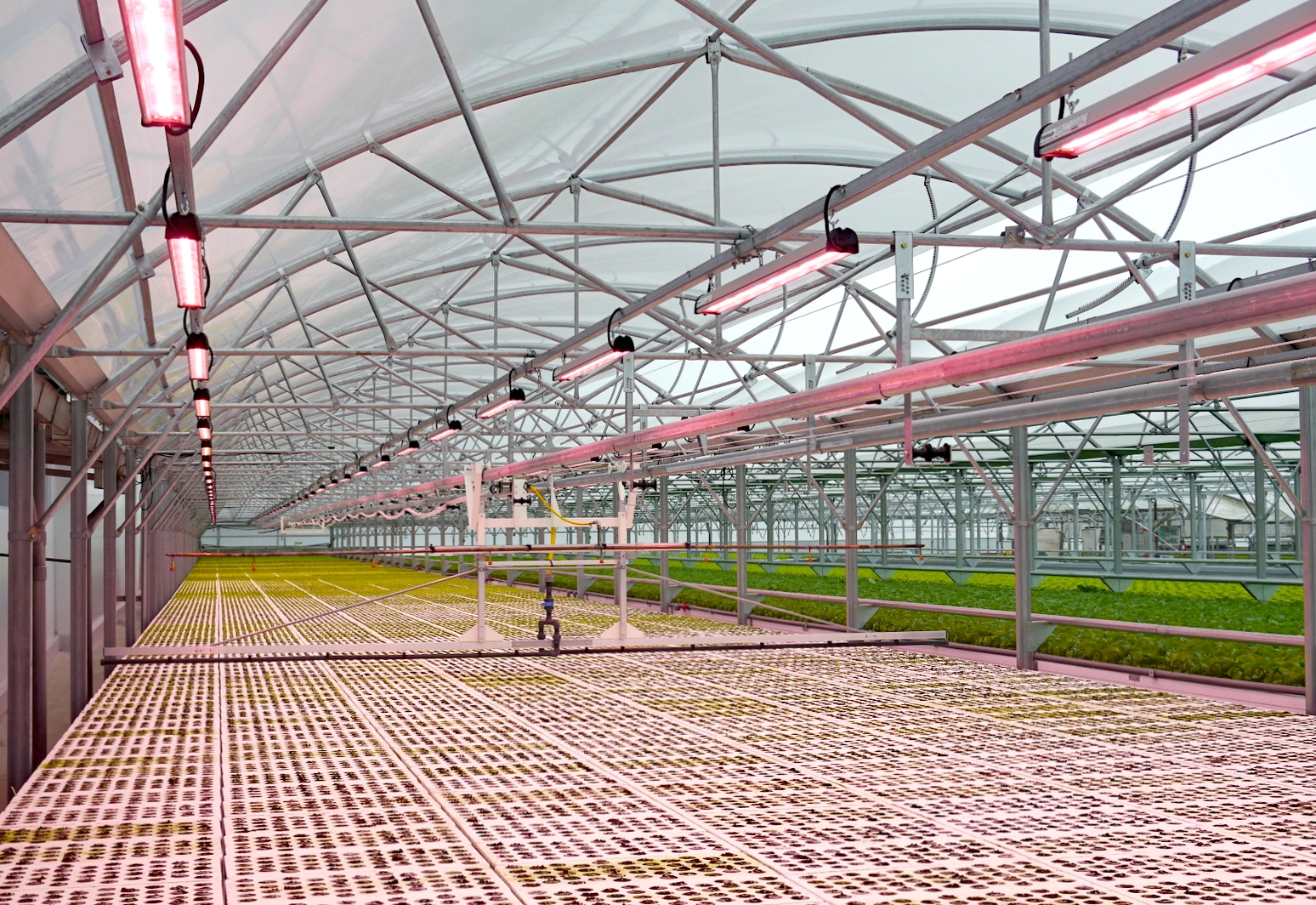
A precise water plan only performs if the tunnel is engineered to carry it, which is why the design details matter. A curved Gothic roof sheds snow and resists wind so covers and crop survive the shoulder seasons. Galvanized steel extends film life. Generous top clearance keeps the microclimate stable and lets machinery work inside. And gutters built to harvest rather than merely shed water make the structure part of the water system. Harnois builds its large TunnelPro Plus around exactly these features, and it pairs naturally with the irrigation and water-treatment side. None of this is about buying the most advanced structure on the market. It is about matching an engineered tunnel and the right water system to the water reality of a given site.
That reality is moving. A tunnel bought today has to perform in the climate of 2050, not 2026, and peer-reviewed climate-analog work makes that future tangible: many North American locations are projected to feel like a hotter, drier place within a single working lifetime (Fitzpatrick and Dunn, 2019). Specified for that horizon, a field-scale tunnel with precision drip, rainwater storage, and, where it fits, recirculation is not a luxury. For a grower watching the reservoir drop, it is the difference between managing water and being managed by it.
Sources:
2026 wildfire outlook: over 5.5 million acres expected to burn as drought intensifies:
https://www.accuweather.com/en/weather-forecasts/wildfire-forecast-2026-fires-likely-to-burn-over-5-5-million-acres-as-drought-intensifies/1881897
British Columbia funds on-farm water capture, storage and irrigation:
https://www.cbc.ca/news/canada/british-columbia/bc-farmers-drought-provincial-funding-1.7147942
California marks ten years of the Sustainable Groundwater Management Act (SGMA):
https://water.ca.gov/News/News-Releases/2024/Sep-24/SGMA-10-Year-Anniversary
Managing drought and salinity in California strawberries and vegetables (UC ANR):
https://ucanr.edu/blog/e-journal-entomology-and-biologicals/article/impact-current-drought-and-recommendations
The American West is enduring its driest 22-year period in at least 1,200 years:
https://www.pbs.org/newshour/science/west-megadrought-worsens-to-driest-in-at-least-1200-years
Water availability and its impact on California agriculture (PPIC):
https://www.ppic.org/blog/testimony-water-availability-and-impacts-on-californias-agriculture/
What will your region’s climate feel like in 60 years? Future Urban Climates (UMCES):
https://www.umces.edu/futureurbanclimates/