
This post is also available in:  English
Every week, someone asks a version of the same question: “How much does a greenhouse cost?” The honest answer is that it depends on a long list of variables, but there is a smarter question hiding inside that one: what does a well-equipped mid-tech greenhouse actually cost, and what should you prioritize first?
This article answers that question with a concrete reference project, real equipment categories, and a clear-eyed look at where the money actually goes. No industry averages, no vague ranges. Just the framework you need to build a profitable baseline.
The Reference Project
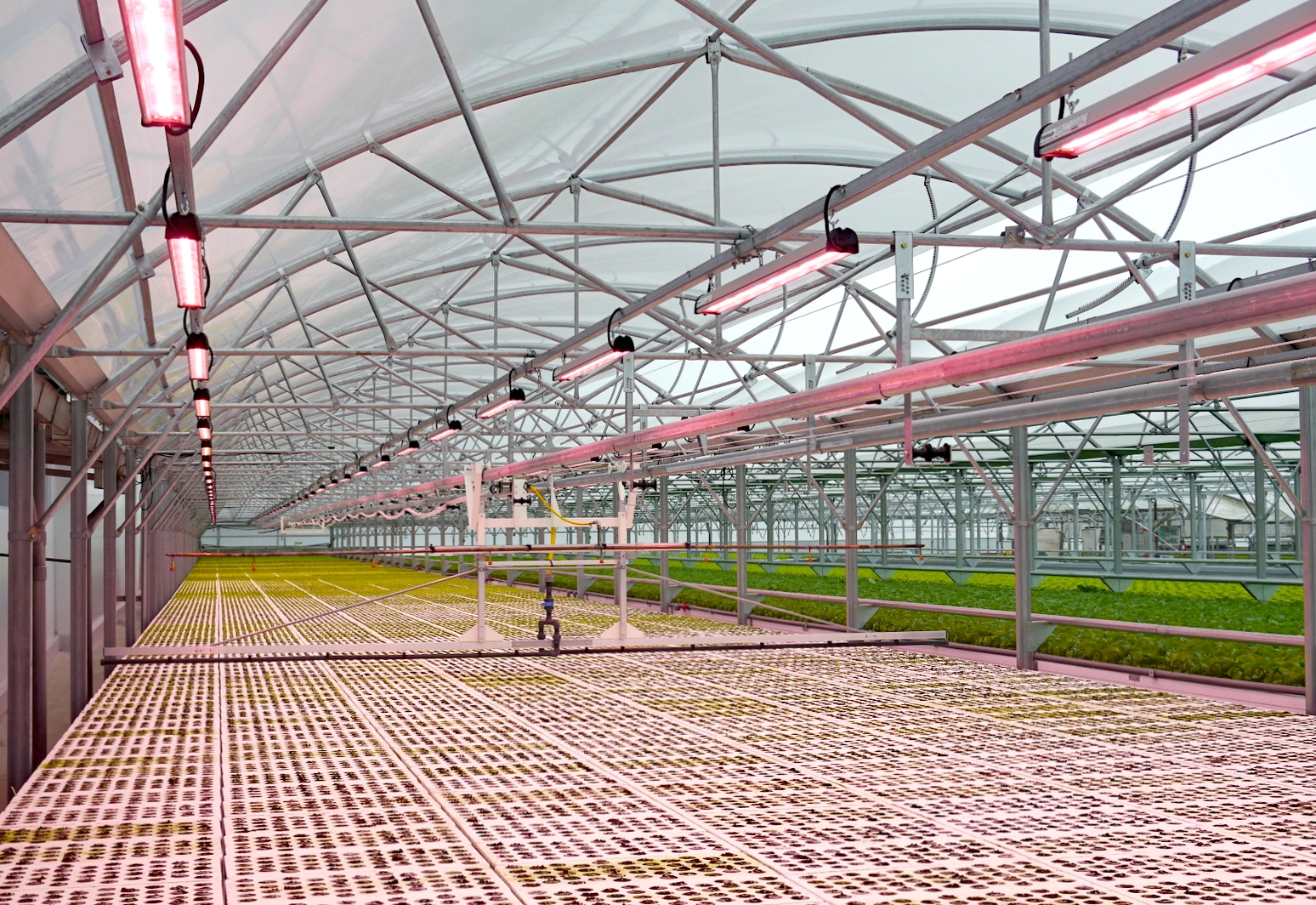
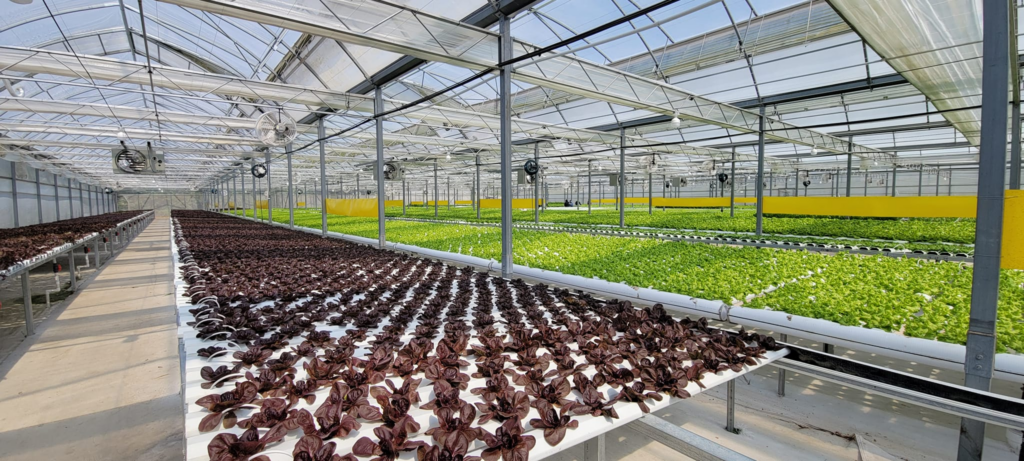
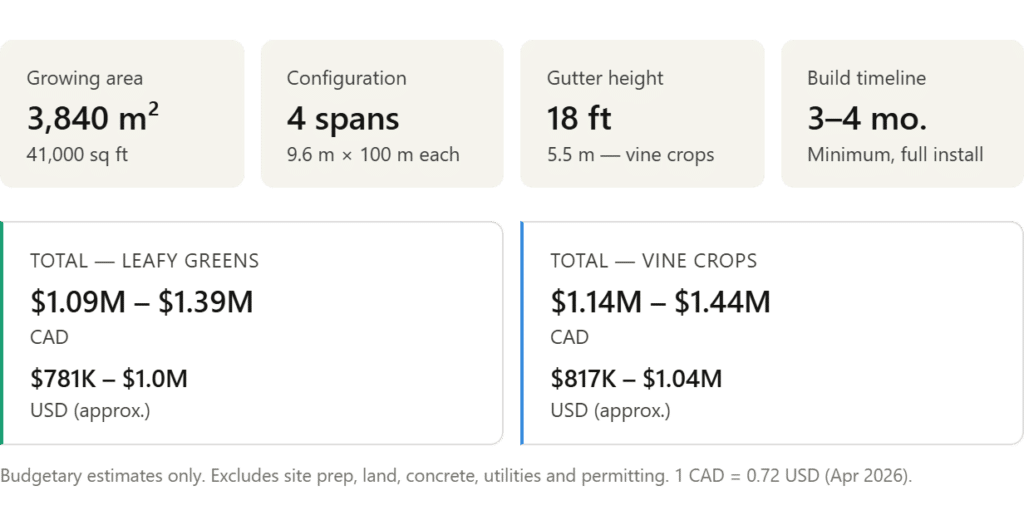
The greenhouse we are working with is a Luminosa multispan structure: 4 spans of 9.6 m (31’6″) wide, 100 m (328′) long, for a total growing area of approximately 3,840 m² (41,000 sq ft). Gutter height is set at 18′ (5.5 m).
That last number matters more than most growers realize. A 16′ under-gutter height works well for leafy green production, lettuce, herbs, and similar crops with a low canopy. But for vine crops like tomatoes and cucumbers, 18′ is the minimum you should seriously consider. You need the air mass volume to buffer temperature swings, the vertical clearance for crop height and wire systems, and the physical space for your heating infrastructure, hanging equipment, and grow wires. Building at 16′ and wishing you had more headroom is an expensive regret.
Location Is Not a Detail, It Is a Structural Variable
Before any quote becomes a real number, your project location has to be locked in. Wind load, snow load, and intended crop load directly determine the steel structure calculation. A greenhouse designed for the Carolinas is not the same structure as one built for Quebec, Manitoba, or the Canadian prairies. The snow and wind exposure categories in colder or more exposed regions require heavier steel profiles, additional structural reinforcements, and sometimes specific foundation engineering.
This is not a place to value-engineer. A structure that is undersized for its climate is a liability from day one. Work with a manufacturer like Harnois, who will calculate the structure to the specific requirements of your site, not to a generic standard. Harnois is a global North American manufacturing greenhouse for heavy-snow areas like Quebec, but also very windy, warm locations like the Bahamas, Bermuda, and Mexico, of course, for the largest vine-crop growers.
The Greenhouse Structure: Your Most Important Investment
Let us address something directly: the greenhouse structure is not where you cut corners. It is the tool you will use every single day for the next 20 to 30 years. The best growers in the industry consistently invest a bit more in a higher-performing, more durable structure, and they are right to do so.
Here is the logic: a well-built structure with a proper double-poly covering system, well-sealed gutters, and reliable ventilation is the foundation of your climate management. When the structure performs, you spend less energy fighting heat loss, humidity imbalances, and condensation drip. You can focus your attention where it belongs: agronomic performance, product quality, post-harvest handling, and your distribution system. A greenhouse that underperforms structurally creates noise that never goes away.
There is also a peace-of-mind dimension that is easy to underestimate. A solid, durable structure frees up your mental bandwidth to focus on what actually drives profitability: plant health, product consistency, and customer relationships. Budget the structure as your primary capital asset, not as a cost to minimize.
Essential Equipment: What You Actually Need at Startup
A mid-tech setup is not a stripped-down setup. It has a defined, functional baseline that gives you meaningful environmental control without the capital intensity of a full high-tech operation. Here is what that baseline looks like.
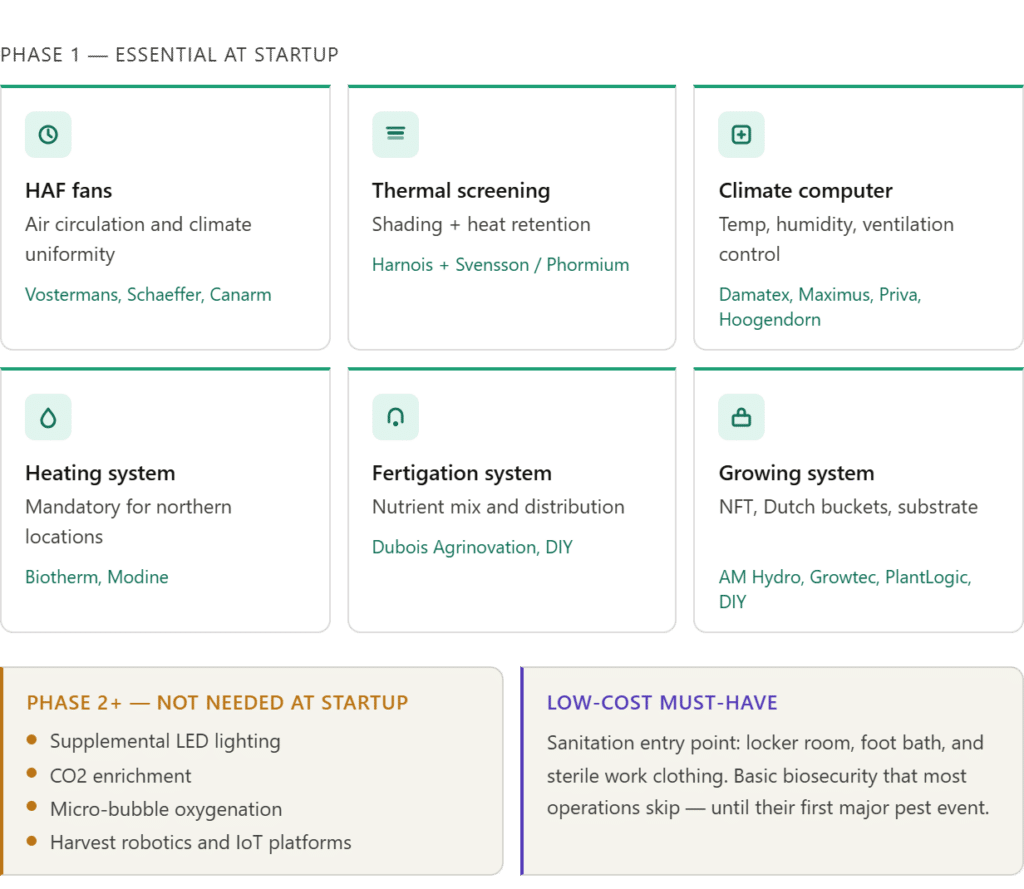
Horizontal Airflow Fans (HAF) are non-negotiable. Air movement is the cheapest and most effective tool for achieving a uniform climate inside the greenhouse. Vostermans, Schaeffer, and Canarm all offer reliable options for this market. Size and position them correctly for your span and crop height.
A shading and thermal screening system serves a dual function: it protects your crops from excessive radiation during summer peaks and significantly reduces heat loss during cold nights. Harnois offers integrated screening systems using Svensson or Phormium cloths, both of which have strong track records in Canadian and northern US conditions. The energy savings from a properly specified thermal screen pay back the investment faster than most growers expect.
A climate control computer is essential, but you do not need the most sophisticated system on the market at startup. Platforms from Damatex, Maximus, Priva, or Hoogendorn all have entry-level configurations that handle temperature, humidity, ventilation, and screening logic with precision. Master the fundamentals of one system before considering upgrades.
A heating system is mandatory for any northern location. Biotherm and Modine are both established names in the North American greenhouse heating market. Your system should be sized for your peak winter load with a reasonable safety margin. Undersized heating in a polar vortex event is a crop loss waiting to happen.
A fertigation system is where you can exercise real judgment on cost. Dubois Agrinovation offers reliable, purpose-built systems for the greenhouse market. A well-designed DIY setup can also work at this scale if the plumbing logic is solid and the injection ratios are verifiable. What matters is precision and consistency, not brand name.
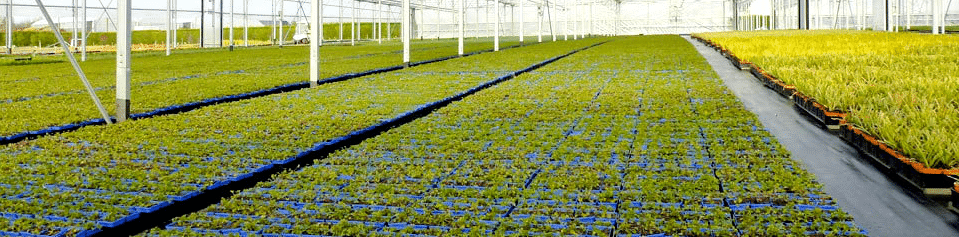
Your growing system, whether NFT channels, Dutch buckets, deep-water culture, or substrate tables, should match your crop and your team’s technical skill set. AM Hydro, Growtec, PlantLogic, Metero, and well-executed DIY solutions all have their place. Do not over-engineer the growing system before you have validated your agronomic protocol.
What you do not need yet. Supplemental LED lighting, micro-bubble oxygenation systems, and CO2 enrichment equipment are Phase 2 and Phase 3 technologies. Each one has a real ROI story, but only once your baseline is dialed in and your per-unit production cost is known and stable.
One low-cost item often skipped: a proper sanitation entry point. Dedicated sanitation systems are frequently prohibited by regulation at the startup stage, but a controlled locker entrance with a foot bath and sterile work clothing is both affordable and immediately effective. It is a basic biosecurity measure that most operations underestimate until their first major pest or disease event. No excuses for skipping this one.
Installation Costs: The Number Most Business Plans Get Wrong
Equipment costs are visible. Installation costs are where projects quietly go over budget.
Start with site selection. A flat site with a 1 to 2% slope maximum dramatically reduces your site preparation costs. Every degree of grade beyond that means more earthwork, more drainage complexity, and more foundation engineering. Access to quality fresh water, three-phase electricity, and natural gas for northern locations should be confirmed before any purchase order is signed.
For the greenhouse assembly itself, use your best-qualified workers for pre-assembly and structural work. Harnois and similar manufacturers can provide a site supervisor to manage the technically complex phases, particularly foundation anchoring and double-poly installation. That supervision cost is a fraction of what you would pay for errors or rework. If none of your team has greenhouse assembly experience, a full installation service from the manufacturer is available, but budget for it honestly. Full-service installation can reach 70 to 80% of the greenhouse structure cost as an additional line item. Get that number in writing early.
Also check local concrete prices before finalizing your budget. Foundation slabs and footings are priced in your local market, not your manufacturer’s catalog, and regional variation is significant.
Scale When You Are Ready, Not Before
Once your operation reaches cruising speed, with stable production costs, consistent market relationships, and predictable cash flow, the path to adding advanced technologies becomes clear and financially justified. Supplemental lighting, environmental sensors, CO2 monitoring, and real-time IoT platforms all deliver genuine margin improvements when the operations they support are already performing. Layered onto an unstable foundation, they add complexity without return.
Build the baseline right. Hit your numbers. Then grow the system.
Budget Reference: Mid-Tech Poly Greenhouse at 3,840 m² (41,000 sq ft)
Luminosa multispan, 4 spans x 9.6 m (31’6″) wide x 100 m (328′) long, double-poly covered, 18′ under gutter
| Item | CAD (Budget Range) | USD (approx. @ 0.72) |
|---|---|---|
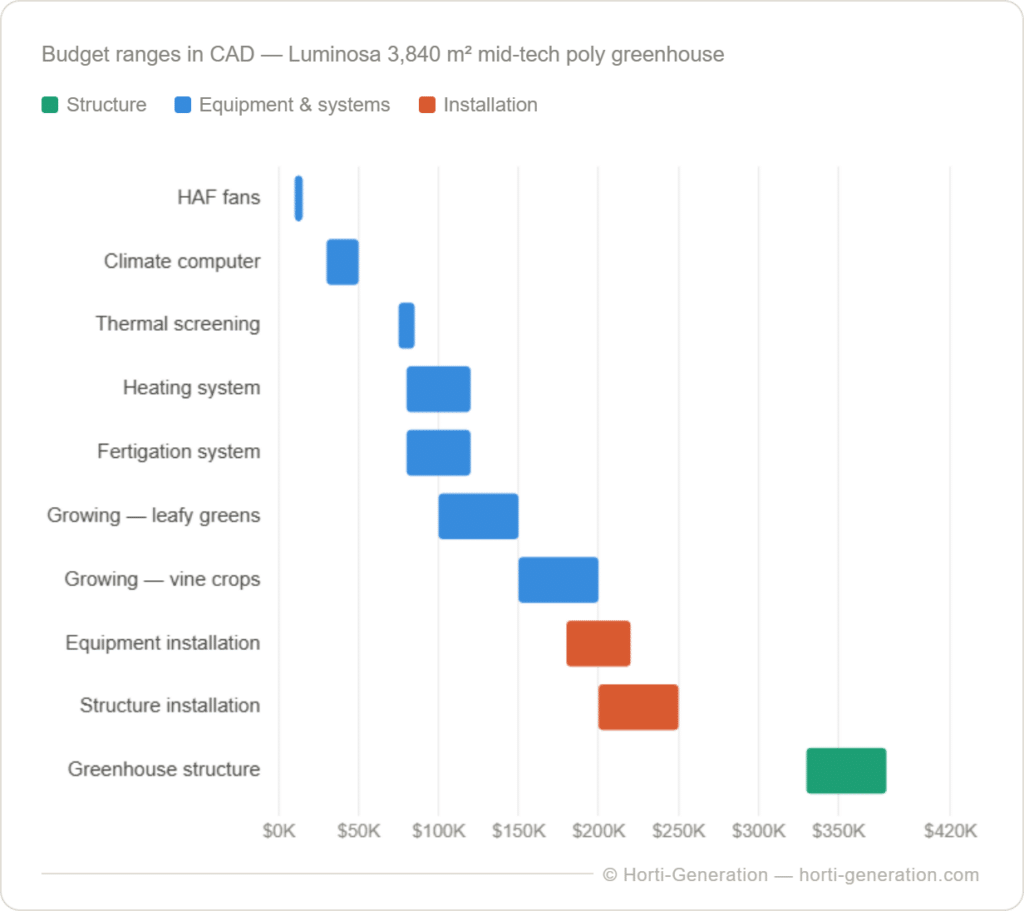
| Greenhouse structure (double-poly, 4 spans, 18′ gutter) | $330,000 – $380,000 | $238,000 – $274,000 |
| Horizontal Airflow Fans (HAF) | $10,000 – $15,000 | $7,200 – $10,800 |
| Shading and thermal motorized screening system | $75,000 – $85,000 | $54,000 – $61,000 |
| Climate control computer + electrical | $30,000 – $50,000 | $21,600 – $36,000 |
| Heating system (highly location-dependent) | $80,000 – $120,000 | $57,600 – $86,400 |
| Fertigation system (mix + distribution) with plumbing work | $80,000 – $120,000 | $57,600 – $86,400 |
| Growing system — leafy greens (mid-tech) | $100,000 – $150,000 | $72,000 – $108,000 |
| Growing system — vine crops (incl. reinforcement + trellising) | $150,000 – $200,000 | $108,000 – $144,000 |
| Greenhouse structure: complete installation | $200,000 – $250,000 | $144,000 – $180,000 |
| Equipment: complete system installation | $180,000 – $220,000 | $129,600 – $158,400 |
| Senior site supervisor | $7,500 / week + travel and accommodations | ~$5,400 / week + travel and accommodations |
| TOTAL — Leafy Greens Configuration | $1,085,000 – $1,390,000 | $781,000 – $1,001,000 |
| TOTAL — Vine Crops Configuration | $1,135,000 – $1,440,000 | $817,000 – $1,037,000 |
| Project timeline | 3 to 4 months minimum to erect and fully install |
Disclaimer: These are highly budgetary estimates for a medium-size (3,840 m²) mid-tech poly greenhouse system under standard North American conditions. Project totals include all line items above except the weekly supervisor fee, which varies by project duration. Site preparation, land, concrete work, utility connections, and permitting are not included and must be budgeted separately. For projects in remote areas or extreme climatic conditions, costs can be significantly higher. USD conversion based on an approximate rate of 1 CAD = 0.72 USD (April 2026). Always obtain site-specific quotes before finalizing any project budget.
Bottom Line
A smart mid-tech greenhouse is not cheap, and it is not supposed to be. It is a precision production tool designed to perform reliably for decades. Invest in the structure, equip the essentials, skip what you do not need yet, and control your installation costs with the same discipline you will bring to your agronomic management. That sequence, executed correctly, is what turns a greenhouse project into a profitable business.
Planning your first commercial greenhouse or evaluating the next phase of expansion? Connect with the Horti-Generation community for independent, field-tested advice.
Go Further